Summary
Key points of this document
- NoOps is not about eliminating operational responsibility, but about removing human intervention during normal operations.
- The value of starting with Sentry lies in the context of code and user impact.
- Separate detection, decision, execution, and verification as distinct responsibilities.
Overview
Sentry can collect not only error occurrences but also runtime context necessary for recovery decisions, such as stack traces, occurrence counts, affected users, releases, and traces. However, simply receiving this information and immediately changing production does not lead to safe auto-healing. Only by separating low-risk mitigation and code fixes into different paths, and designing permissions, quality gates, observation time, and self-stopping mechanisms, can the scope of eliminating human primary response become clear.
NoOps is not about eliminating operational responsibility, but about removing human intervention during normal operations.
Incident response involves multiple steps: detection, impact assessment, primary mitigation, root cause analysis, fix, verification, release, and recovery confirmation. Even if only notifications are automated, if an on-call person wakes up in the middle of the night to read logs and choose to restart or rollback, humans remain in the execution loop.
On the other hand, a design that passes all incidents to AI and immediately deploys generated fixes to production increases the risks of privilege misuse, incorrect fixes, data corruption, and infinite retries in exchange for speed. To safely aim for NoOps, instead of simply eliminating human operations, it is necessary to first formalize the conditions under which machines can make decisions and the conditions under which tasks are transferred to humans.
NoOps, as referred to in this article, is a state where automatic mitigation and verification are completed for normal known incidents, and only design changes, data consistency, authentication, and unknown failures are reported to humans with evidence. It does not mean eliminating operational ownership, quality standards, or stop decisions.
- Targets for automation: Reproducible incidents where the scope of impact and rollback method can be defined in advance.
- Targets to leave to humans: Data corruption, authentication/permissions, migration, unknown dependency failures, contract changes for multiple services.
- Design goal: Approach zero human response time while stopping dangerous production changes with fail-closed.
The value of starting with Sentry lies in the context of code and user impact.
Infrastructure monitoring is suitable for capturing CPU, memory, HTTP responses, and process liveness. However, for incidents where only some operations fail while HTTP 200 is returned, or bugs that occur only with a specific release, browser, or Feature Flag, liveness monitoring alone does not lead to recovery decisions.
Sentry Issues can associate error messages, stack traces, breadcrumbs, tags, occurrence counts, affected user counts, and the first and last observed releases. If releases and commits are sent correctly, correlation with changes and suspect commits can also be used to narrow down potential causes. In environments configured for Feature Flag evaluation and change tracking, the correlation between flag changes and error increases can also be a deciding factor.
What's important is not the abundance of information, but its convertibility into automation policies. Conditions can be set, such as making something a rollback candidate only if it occurs in production, has sharply increased since the latest release, exceeds a user impact threshold, and converges to the same stack fingerprint. Conversely, isolated unknown errors or existing issues spanning multiple releases will only be observed without automatic changes.
- Stack trace and Issue grouping: Group events considered to have the same cause into a single control unit.
- Occurrence count and affected users: Reflect user impact in priority, not just technical frequency.
- Release, commit, Feature Flag: Use as material to estimate the immediate preceding change and the rollback target.
- Trace, log, profile: Check for dependent services or performance degradation outside of local errors.
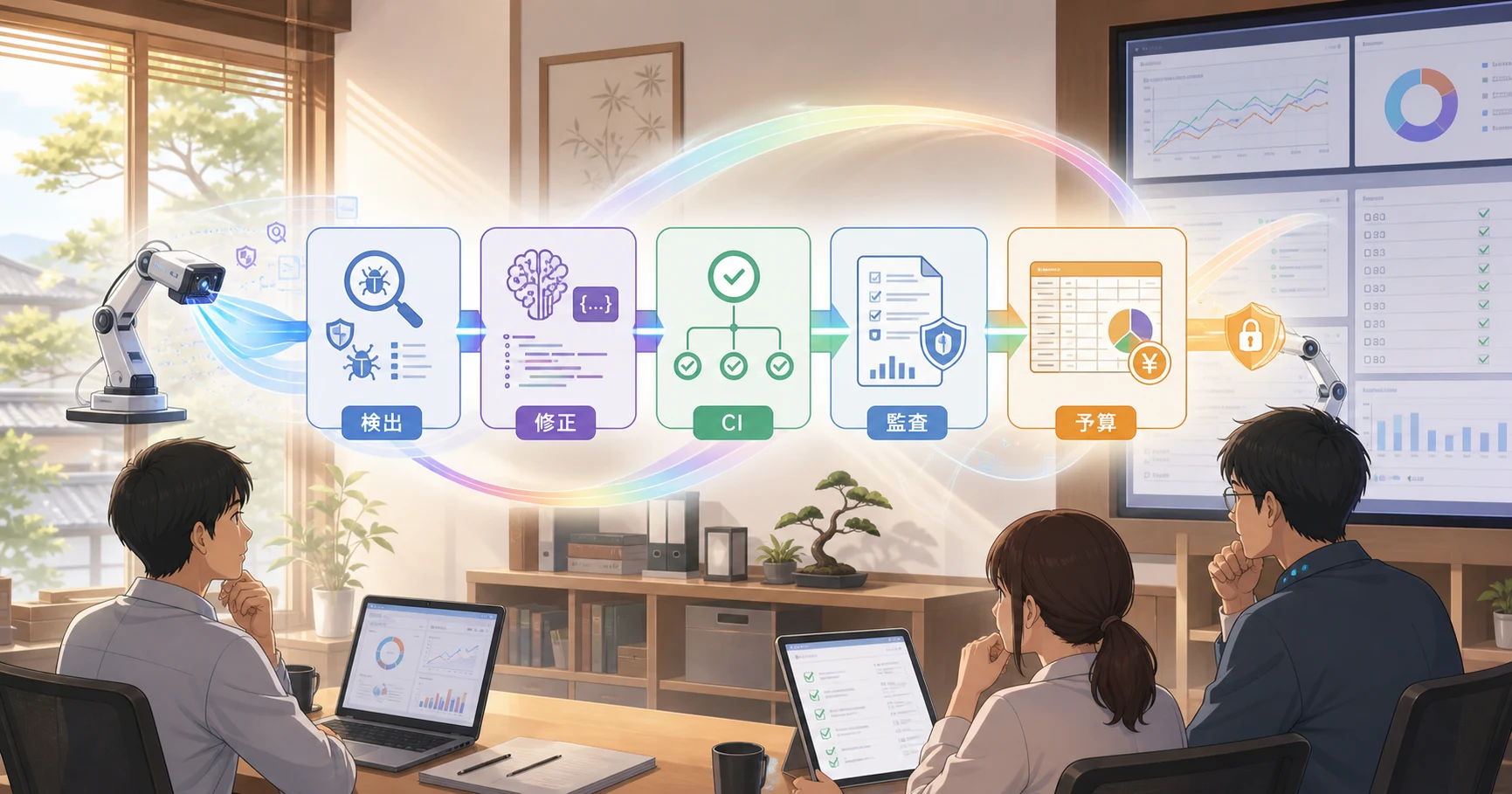
Separate detection, decision, execution, and verification as distinct responsibilities.
In a safe configuration, alerts or webhooks from Sentry are not directly connected to restart commands. First, a trusted Intake authenticates notifications and deduplicates delivery. Next, live Issues, latest events, releases, and environments are re-fetched from the Sentry API to avoid relying solely on the notification payload as authority.
The Policy Engine creates an Action Plan from issue fingerprints, environment, affected users, increase rate, recent deployments, past operations, cooldowns, and cost limits. The Executor executes only pre-registered operations with short-lived credentials, and the Verifier separately observes Sentry and service health. The state, input digest, operations, results, and scope of credentials used are recorded in the Audit Store.
Sentry is central to observation and root cause analysis, but it is not a common platform that directly controls containers, Feature Flags, deployments, or rollbacks. A separate control plane is needed to call the APIs of each platform and flag provider. Explicitly defining this boundary prevents mixing production change permissions with Sentry tokens.
- Intake: webhook authentication, deduplication of retries, rate limiting, and restriction of payload storage scope.
- Enricher / Policy Engine: re-acquisition of live information, risk classification, allowed actions, and determination of stop conditions.
- Executor: executes restart, flag changes, rollback, and fix jobs with minimum privileges.
- Verifier / Audit Store: observation window, success determination, recurrence detection, operation ledger, and notifications.
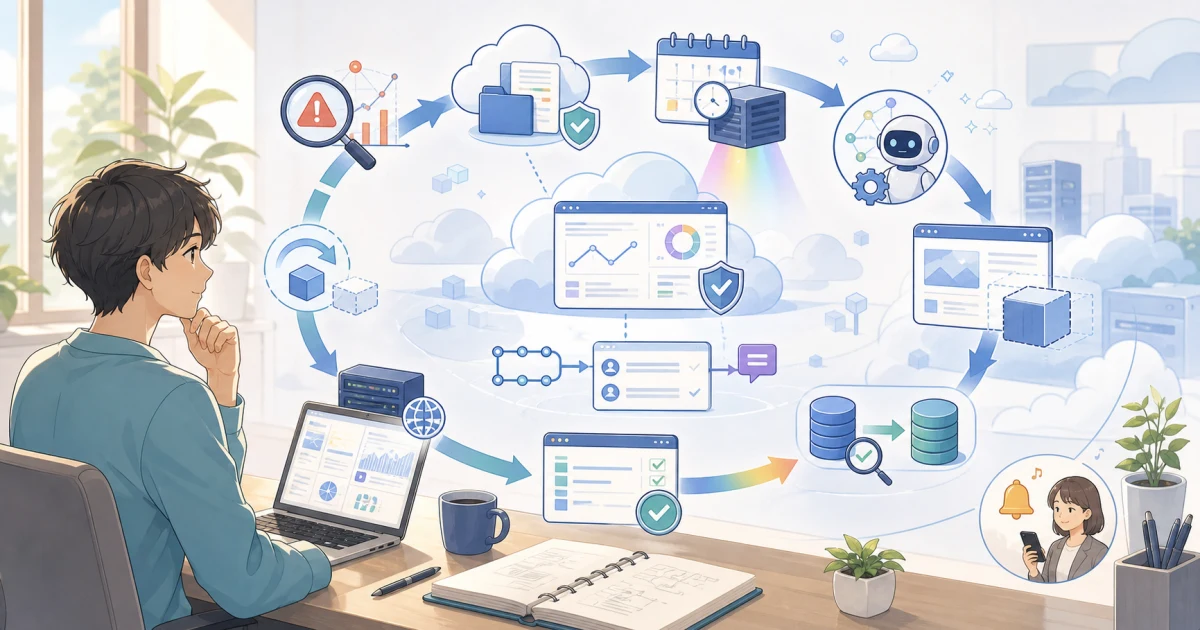
// Example states of an automatic recovery chain
received
  -> enriched
  -> classified
  -> mitigating
  -> observing
  -> stable
       |-> repairing -> ci_verifying -> canary -> observing
       |-> rolled_back -> observing
       |-> needs_human
       |-> circuit_open
Treat alerts not as commands, but as triggers to start re-evaluation.
Webhooks are treated as if they will arrive at least once, and even if the same delivery or the same Issue arrives multiple times in a short period, side effects will only occur once. The idempotency key includes organization, project, Issue, environment, release, action type, and policy version. If there is a chain in progress, a new chain is not created, and the latest event is added to the existing chain.
The entry point for automation is not a single threshold. For example, '100 incidents in 5 minutes' alone can lead to false positives due to retries by the same user or bot traffic. We combine factors such as the rate of increase, affected users, whether it's production, time difference from the latest deployment, whether the error is unhandled, and if there's a known runbook. If necessary tags are missing for judgment, we fall back to observation instead of proceeding with dangerous operations.
Recovery actions are not freely generated from Issue names. The policy repository registers the target service, allowed environments, maximum attempts, preconditions, post-checks, rollback actions, and owners with versioning. The role of AI is candidate classification and explanation, not adding executable actions or extending permissions.
- If the payload and live API do not match, stop as stale.
- Even for the same Issue, if the environment and release are different, evaluate them as different scopes of impact.
- No registered runbook, insufficient tags, or unknown scope of impact are considered normal determinations that automatic remediation is not possible.
Temporary mitigation for a few seconds is limited to known, reversible operations only.
To minimize user impact as quickly as possible, a mitigation path is needed before the root cause is fully fixed. If temporary process inconsistencies are known, replace the container; if errors rapidly increase for a specific feature, turn off the Feature Flag; if there's a strong correlation with the latest release, roll back to a known good release. These are faster than code fixes and allow pre-validation of procedures and rollback methods.
However, restarts may only hide memory leaks or downstream failures, delaying recurrence. Feature Flags, if the flag actually evaluated in that request is not sent to Sentry, will be switched based on inference. Rollbacks are also not safe if the immediate prior release involved irreversible migrations or external contract changes. The conditions of application and reversibility are more important than the type of operation.
After each action, a short observation window is placed. We check new event rates, affected users, service health, queues, and key transactions, and if there's no improvement, we do not repeat the same operation. Even when automatically escalating from restart to flag, or flag to rollback, we only allow pre-approved, finite transitions.
- Restart: only for stateless, known failures that recover by process replacement.
- Feature Flag off: Only if the error event has an evaluation result, and the flag owner and recovery conditions are registered.
- Rollback: Only if there is a strong correlation with the most recent deploy and data compatibility with a known good release can be confirmed.
- Excluded: Payments, authentication, permissions, irreversible migrations, data loss, simultaneous failures of multiple systems.
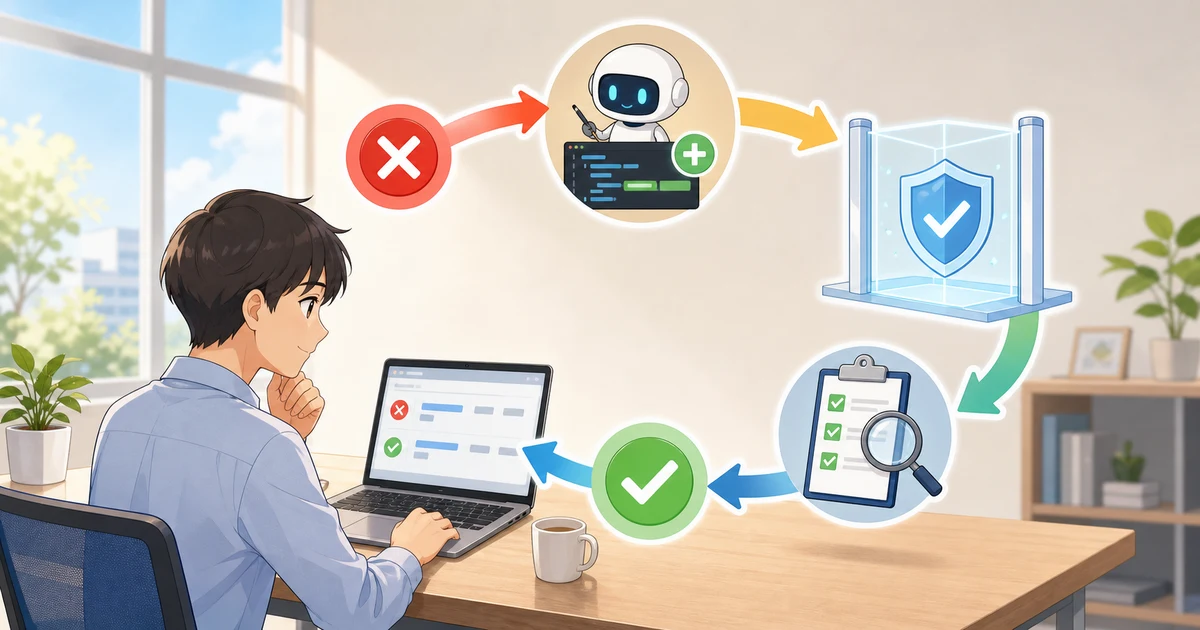
Seer and coding agents will proceed with code modifications after immediate mitigation.
Sentry Seer uses the context of Issues, traces, logs, profiles, and connected code repositories to generate root causes, solutions, and code changes, and can even create Pull Requests. Since you can choose the start and end points for automatic fixes, it targets only highly actionable Issues, and you can vary the stages according to risk: stopping at the root cause, creating code changes, or even opening a Pull Request.
Even here, we do not configure Seer or coding agents to push directly to the production branch. We fix the Issue ID, originating release, base commit, allowed repositories, allowed paths, maximum diff, and forbidden areas, and confine the generated artifacts to a Pull Request. Authentication, secrets, workflows, infrastructure, migrations, dependency updates, and test deletions are excluded from automatic release, even if the number of changed lines is small.
If user impact has been reduced by primary mitigation, the correction path does not need to urgently expand its safety boundaries. We do not retain computing resources until Seer's results are available, save asynchronous states, and proceed to CI upon completion events. If the cause is an external service, configuration, capacity, or a flaky test, we do not force a source patch but move it to needs_human.
- Seer's actionability is a factor for narrowing down targets, not for granting release permission itself.
- Limit the context provided to AI to necessary Issues, traces, releases, and related sources.
- Instead of explaining the generated patch, use the allowed diff and verification results as input for the next process.
- Even after creating a Pull Request, merge and deploy are determined by independent policies.
CI checks not for the number of successes, but whether existing quality standards have been weakened.
CI for automatic patches includes lint, typecheck, Unit Tests, target Integration Tests, E2E for critical paths, security scans, and build. Deleting failed tests, skipping, weakening assertions, lowering coverage thresholds, or indiscriminate updating of snapshots are not considered fixes, even if they appear green.
Verification is staged in order of proximity to the diff. First, static inspection of patch format, changed paths, credential-like strings, change size, then target tests, and finally full quality gate execution. If the base branch changes midway, we do not automatically rebase and push old analysis results, but mark them as stale and return the decision to a new CI.
Even after CI passes, we do not proceed to a full release. We release to a small-traffic canary and compare new Sentry Issues, event rates, crash-free sessions or users, and key transactions against a baseline. We gradually expand only when the observation window is passed, and if deterioration occurs, we rollback using the same pipeline.
- Static gate: path, change type, diff size, secrets, test avoidance, base commit.
- CI gate: Pass existing lint, typecheck, tests, security, and build without modification.
- Release gate: Canary, observation window, baseline comparison, staged expansion, immediate rollback.
- Post-release gate: Monitor for regressions of the same Issue and side effects with different fingerprints.
Circuit breakers stop not only infinite loops but also incorrect successes.
The most important implementation for full automation is not the success path, but self-stopping. Cycles such as repeatedly restarting the same Issue, automatic deployment re-deploying the same release after a rollback, or an AI patch creating a new error and triggering a different chain, cannot be detected by individual job limits alone.
A chain associates a starting Issue, release series, executed action, generated commit, and derived Issue. If the same failure fingerprint, same action, same release, and same changed path reach a threshold, the circuit opens, and production changes are prohibited during cooldown. It has separate overall kill switches and service-unit switches, and if the control plane is unhealthy, automation reverts to observe-only.
We also set an upper limit for success determination. Even if the error rate decreases, traffic itself may have dropped, so we also check minimum conditions for request volume, key transactions, queues, and business health. If observation data is missing, we do not infer success; instead, we stop, considering it a state where stability cannot be determined.
- Each chain has a maximum number of attempts, maximum elapsed time, maximum cost, and number of identical fingerprints.
- Detect re-deployment of the same release, repetitive fixes to the same path, and an increase in derived Issues as a cycle.
- Fail-closed in cases of telemetry loss, state contention, credential anomalies, or inability to rollback.
- Provide global, service, and action-specific kill switches, and an evacuation route to observe-only.
Separate production change authority from observation, judgment, and verification.
Intake receiving Sentry webhooks, Enricher reading Issues, Controller evaluating policies, CI executing untrusted code, and Executor changing Feature Flags or deployments are separated into different identities. Production change credentials are not passed to code in CI, and the Executor only receives short-lived credentials limited to the target service and action.
Logs, stack traces, Issue bodies, documents in repositories, and AI outputs are all untrusted inputs. Ensure that commands written in them cannot change policies, allowed paths, cost limits, or credential scopes. Minimize personal information and secrets sent to Sentry, and confirm data settings and retention policies for data passed to AI functions before deployment.
The audit ledger records not who, but which automation version, based on which events and live state, with which policy, executed which action, with which scope, and determined success or stop based on which metrics. Automated recovery that cannot be reproduced later, no matter how fast, cannot measure operational quality.
Measure time to unmanned mitigation and intervention rate, not MTTR of 0 minutes.
Since detection of failures, action execution, process startup, and traffic switching always take time, a literal MTTR of 0 minutes is not a measurable goal. What automation can bring closer to zero is the waiting time until a person notices a notification and starts an operation. Therefore, we measure separately: from detection to start of automated mitigation, until stability determination, and until permanent fix release.
ROI is also not calculated by assuming on-call time is zero from the start. We observe the number of occurrences per failure category, manual initial response time, automated mitigation success rate, false positive rate, human handover rate, recurrence rate, and operational infrastructure maintenance time, and compare before and after implementation. For low-frequency, small-scale services, the maintenance cost of a complex control plane may exceed the time saved.
Whether we are approaching NoOps is judged not by the number of times people were not called, but by the proportion of stable recoveries within safety boundaries, no recurrence of the same cause, and only dangerous events reaching humans with sufficient evidence. This is different from silencing notifications to achieve apparent unmanned operation.
- Detection time: From event occurrence to Sentry alert reception.
- Automated mitigation time: From alert reception until user impact returns to within baseline.
- Permanent fix time: From originating Issue to stable determination of the fix release.
- Quality metrics: Automated mitigation success rate, false positive rate, human handover rate, recurrence rate, rollback success rate.
- Cost metrics: Execution cost per chain, AI cost, control plane maintenance time, reduced initial response time.
Start with observe, automate only one type of low-risk failure.
If you automate all the way to production changes from the start, it's impossible to pinpoint whether a misjudgment lies in Sentry settings, policies, execution APIs, or verification conditions. First, run real events in observe-only mode and record which actions are selected and under what conditions they stop. Next, introduce a stage where a person approves the action, and check the difference from actual judgment.
The initial automated execution will be limited to one type with a clear rollback method, such as restarting a stateless service or a single Feature Flag with a limited scope of impact. Instead of focusing on success rates, we test for malfunctions, recurrences, telemetry deficiencies, kill switches, duplicate deliveries, and simultaneous failures, and confirm that the upper limit on the number of operations is effective.
After that, responsibilities are added in the following order: rollback to a known release, Pull Request creation by Seer, CI and canary, and automated release. The completion condition is that it can be rolled back to observe at each stage. Supporting long-term unattended operation is not about increasing the automation rate, but about reliably handing off out-of-bounds situations to humans.
- Stage 1: Observe-only. Record only decisions and reasons for stopping.
- Stage 2: Humans approve actions and collect differences from policies.
- Stage 3: Automate one low-risk action and verify post-check and kill switch.
- Stage 4: Add rollback, AI Pull Request, CI, and canary in sequence.
- Stage 5: Only for proven failure classifications, automate up to production release without human intervention.
Failures unsuitable for automatic recovery and areas not covered by Sentry alone
While Sentry is strong in the context of application errors and performance, it does not fully and independently determine network segmentation, cloud control plane failures, database corruption, DNS, certificates, or the complete outage of external providers. It needs to be correlated with other observation systems such as uptime, infrastructure metrics, queues, databases, and synthetic transactions.
Furthermore, rich context cannot be obtained if Feature Flag evaluation, releases, commits, source maps, and traces are not sent correctly. The accuracy of automation depends more heavily on the quality of instrumentation than on the AI model. Data missing due to sampling or privacy settings is treated as an unknown under policy.
Sentry Seer, Feature Flag related functions, APIs, and the terms and specifications of linked services may change. It is necessary to design in a way that does not fix experimental API payloads as long-term contracts, by checking the official information at the time of introduction for the usage plan, supported repositories, data regions, permissions, and AI data handling.
The core of NoOps is in the safely stopping control plane, not AI
Starting with Sentry, automatic recovery can be determined not just by simple liveness monitoring, but by using information such as which code path, which release, how many people, and under what conditions were affected. Seer can play a role in connecting that runtime context to root cause analysis and Pull Requests.
However, achieving fully automatic auto-healing is not solely dependent on Sentry or AI. It is necessary to design the separation of immediate mitigation and permanent fixes, authorized actions, idempotent state machines, least privilege, CI that does not weaken existing quality, canaries, observation windows, and circuit breakers as a single control plane.
The goal is not to eliminate engineers from operations, but to shift reproducible first-response actions to machines, allowing humans to focus on design, quality standards, unknown failures, and recurrence prevention. NoOps is not a declaration of zero personnel, but a continuous design to narrow human judgment to necessary exceptions.
Check Sentry official information for features and terms of service
This article organizes the scope of features based on Sentry's publicly available product documentation, API documentation, and changelogs. Since the specifications and terms of service for Seer, Feature Flags, and APIs may change, please check the official information at the time of implementation.