Summary
Key points of this document
- "Not touching" also turns into a risk over time.
- Step 1 | Create a "System that's OK to Break" Before Touching Code
- Step 2 | Continue the Boy Scout Rule, with Delimited Differences
Overview
In environments with significant technical debt, the decision "don't touch it because it's risky" can often seem like the safest option. However, even without making changes, dependent libraries become outdated, personnel transfer, and disaster recovery procedures become ambiguous. The starting point for progress is to redesign safety not just through caution, but by creating a state where failures can be detected, rolled back, and learned from.
"Not touching" also turns into a risk over time.
It's a natural reaction to be afraid of making major changes to a running system. Few tests, invisible dependencies, many manual tasks, and uncertainty about how far back you can roll in case of a failure. If you start a large-scale refactoring in this state, the change itself can become the cause of a failure. That's why, first, instead of stopping changes, we invest in mechanisms that minimize the impact of failed changes.
Maintaining the status quo is only safe if surrounding conditions don't change. Support deadlines for dependent libraries, OS and execution environment updates, data volume, increased users, and personnel changes all progress even if you don't touch the code. The decision not to change doesn't eliminate risk; it often moves it to an invisible place, to be paid for all at once later.
Technical debt here is not limited to old code. It also includes maintenance constraints such as difficulty predicting the impact of changes, difficulty detecting failures, inability to execute restoration procedures, and inability to explain the basis for decisions. In these 4 steps, we don't resolve these constraints all at once, but sequentially reduce the damage and investigation time in case of failure.
- Separate conditions under which a "don't touch" decision is valid from conditions that change over time.
- Treat not only code quality but also ease of detection, restoration, and explanation as debt.
- Build a foundation to minimize change failures, rather than undertaking large-scale refreshes.
Step 1 | Create a "System that's OK to Break" Before Touching Code
You don't need to cover all features with tests from the start. First, choose a few critical entry points for users and paths that have broken in the past. For paths with significant impact if they fail and where results can be mechanically verified, such as order/application registration, login, search, or external integrations, add regression tests. For difficult-to-test areas, first fix observable facts like input/output records, data counts, or external call counts.
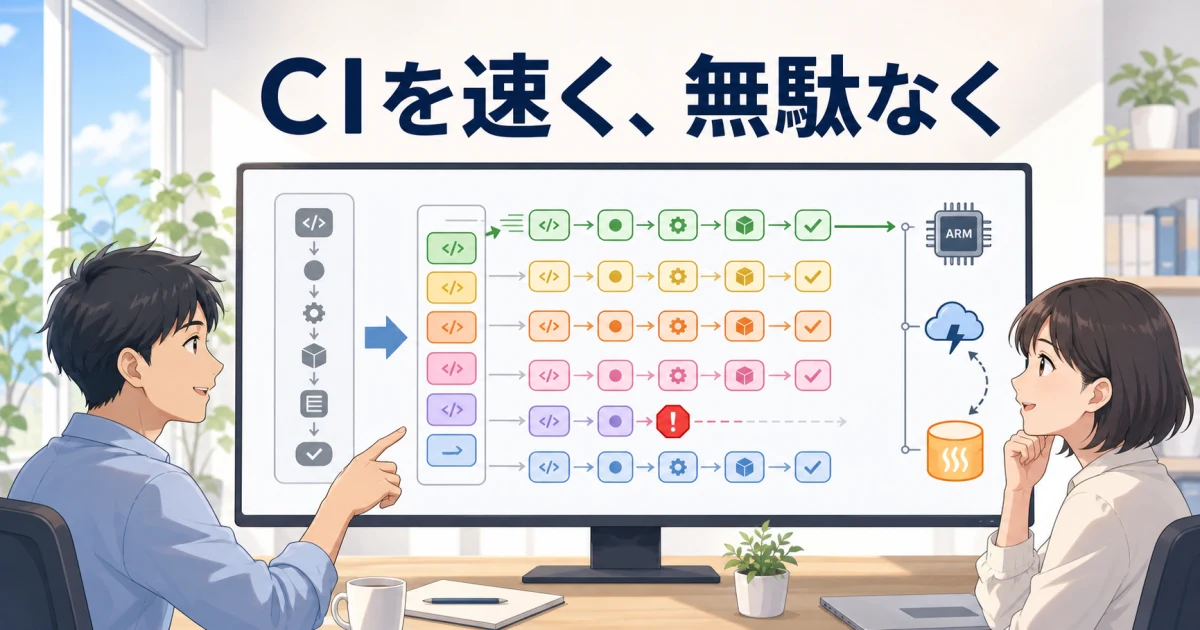
In CI, separate fast checks from heavy checks. Run formatting, type checks, and unit tests with every change, and gradually add contract tests and E2E tests for critical screens. If full tests are too long and no one waits, make selective tests based on change impact a fast path, and continue full tests on main or scheduled runs. This design separates validation by purpose, rather than abandoning validation for speed.
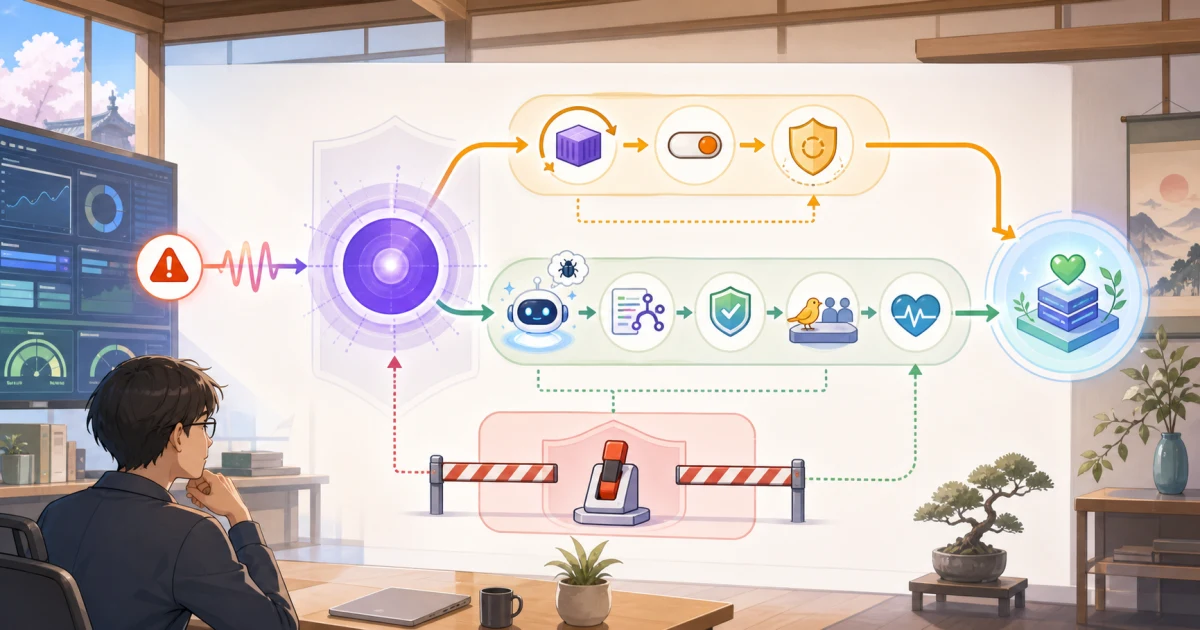
Deployment is also not spread to all users at once. Use canary releases and feature flags to compare new and old behavior with a small amount of traffic. Observe error rates, latency, processing counts, and critical business results, and automatically or manually roll back to the old version if defined conditions are exceeded. "Rollbackable" doesn't just mean having the previous container ready. It includes rollback decision metrics, responsible parties, execution procedures, and verification methods.
- Create regression tests and observation items from critical paths.
- Divide CI into fast checks, impact scope tests, and full tests.
- Define canary expansion and rollback conditions before making changes.
- Separate DB changes into backward-compatible additions, data migrations, and removal of unnecessary items.
// Minimum safety valve to decide before change
before_change:
  observe: [error_rate, latency_p95, key_business_result]
  verify: [typecheck, unit_test, critical_path_smoke]
  rollout: [canary, feature_flag]
  rollback_when:
    - error_rate exceeds baseline + threshold
    - latency_p95 exceeds agreed limit
    - critical_business_result becomes invalid
  owner: named_operator
  evidence: saved_logs_and_test_report
Step 2 | Continue the Boy Scout Rule, with Delimited Differences
A plan to clean up all files at once, while technically correct, is often prone to operational failure. The wider the scope of change, the more review material, the more conflicts, and the harder it becomes to trace what caused behavior changes. The essence of the Boy Scout Rule is to leave the place you touched a little better than you found it. It's not about 'fixing everything while you're at it.'
In practice, first define a budget for differences. For example, limit the scope to files touched during the work, and choose one improvement like renaming, extracting small duplicate processes, adding logs for failures, or adding tests. Separate large formatting-only diffs into a different commit and don't mix them with behavior changes. It's important to maintain a granularity where you can explain 'what became safer with this change' during review.
The order of improvements starts with those that have less impact outside the boundary. Tasks like separating internal responsibilities without changing public inputs/outputs, making implicit settings explicit, or logging exceptions instead of suppressing them are relatively safe. On the other hand, tasks that simultaneously change data models, authentication, authorization, or external integration contracts should not be handled solely by the Boy Scout Rule, but as separate design and migration plans.
- Target only touched files and limit improvements to one or two items.
- Separate commits for behavior changes, formatting, and renaming.
- Treat public contracts, authentication, authorization, and DB deletion as separate design changes.
- Explain what became safer and what risks remain during review.
// Criteria for choosing small improvements
touched_files_only = true
choose_one:
  - add_characterization_test
  - make_hidden_dependency_explicit
  - separate_one_responsibility
  - improve_failure_observability
  - remove_one_duplicate_branch

keep_out_of_this_change:
  - unrelated_formatting
  - public_contract_change
  - database_destructive_migration
  - broad_directory_rename
Step 3 | Visualize the "Risk of Not Fixing" as Interest on Debt
Technical debt repayment is often postponed not because improvements lack value. In many cases, it's because the extra work that repeatedly occurs when left unaddressed is recorded as separate incidents. Record the time spent on investigation, review, manual recovery, and re-asking colleagues, not just during outages but also during normal development.
Choose metrics that can be used for decision-making, rather than those that directly measure code beauty. Examples include investigation time per change, number of review rounds, manual verification after release, time taken for rollback, defects occurring in the same area, and time stopped when the responsible person is absent. Aggregating these monthly can explain how much interest the debt is generating.
For example, multiply the additional verification time per change by the number of changes, and add recovery time during outages and manual work time. Even if you can't get an exact monetary figure from the start, time is sufficient. To counter the opinion that 'it's safer not to touch it,' aim to discuss 'how many hours are continuously spent each month by not touching it' and 'under what conditions are small improvements cheaper' using the same scale.
- Record extra time for investigation, review, deployment, recovery, and handover separately.
- Look at maximum values during busy periods and outages, not just averages.
- Prioritize based on interest and impact of failure, not the size of the debt.
- Prioritize consistent measurement methods for comparison over precise monetary figures.
// Conceptual formula for tracking interest on debt
monthly_interest =
  extra_investigation_hours
  + review_rework_hours
  + manual_release_hours
  + recovery_hours
  + handover_hours

decide_priority_by:
  - monthly_interest
  - failure_impact
  - change_frequency
  - reversibility_after_improvement
Step 4 | Update the Definition of Safety from "Caution" to "Resilience"
If safety is defined solely as "not breaking things," avoiding changes appears safer. However, in complex systems, not all failures can be predicted in advance. Expand the safety criteria from not failing to also include quickly finding failures, containing their impact, reverting to a previous state, and incorporating lessons into the next improvement.
Resilience is not created just by placing monitoring screens. It involves actually testing timeouts and retry limits, external integration disconnections, queue backlogs, startup and shutdown verification, data consistency, and manual rollback procedures. If a restoration procedure has never been executed, it's just a document, not yet a recovery capability.
DB changes, in particular, cannot be rolled back in the same way as application changes. First, add new columns, maintain readability for older versions, gradually populate data, confirm usage, and then deprecate old columns. By designing for forward and backward compatibility separately, you can create boundaries that prevent data corruption even if only the application is rolled back.
- Connect monitoring, logs, alerts, and rollback as a single operational procedure.
- Contain damage during timeouts, retries, queue failures, and external integration failures.
- Verify procedure executability through recovery drills and incident exercises.
- Separate DB changes into addition, migration, and deletion, and make them compatible with app rollbacks.
Integrate the 4 steps into daily development
The 4 steps are not a procedure to complete a large improvement project first and then return to development. First, for one critical path, create tests to detect failures, metrics to observe after deployment, and rollback procedures. The next person who touches that path during a change adds one small improvement. Then, measure the extra time taken and decide the next boundary to tidy up.
For the first month, focus on inventorying fragile paths, minimal CI, and verifying rollback procedures. For the next month, apply the Boy Scout Rule to frequently changed files and record debt interest. After that, expand canary targets and regularize recovery drills and metric reviews. The period will vary depending on the site's scale, but weekly, confirm 'which failures can now be found faster.'
When selecting targets, consider not just the impression of being dangerous, but also change frequency, impact on users, current observability, and ease of rollback. For important but unobservable areas, don't tidy them up immediately; start with logging and testing. For areas with low change frequency and limited impact, don't force immediate fixes; leave the reasoning for the decision so it can be reviewed when conditions change.
- Initially, for one critical path, align detection, rollback, and logging.
- Mix small improvements into daily changes, not dependent on separate large-scale refresh plans.
- Select targets based on change frequency, impact, measurability, and reversibility.
- Each week, we review failures that can be detected earlier and remaining uncertainties.
// Simple score for selecting targets
priority =
  change_frequency
  * failure_impact
  * investigation_cost
  / observability_and_reversibility

start_with:
  - high change frequency
  - high impact when broken
  - measurable behavior
  - small reversible boundary
There are situations where this approach should not be applied.
It is not safe to make small, incremental changes to production code without tests, monitoring, or verification of data backup and restoration. First, establish read-only inventory, log storage, backup restoration verification, and manual rollback procedures. Small differences reduce the scope of investigation in case of failure, but they do not eliminate the possibility of failure.
Furthermore, tasks involving changes in requirement interpretation, authentication/authorization, financial calculations, and destructive data migrations are not simple 'clean up a little where you touched' targets. They require separate safeguards such as design reviews, phased transitions, dual recording, and clear approval processes. Canary releases also do not automatically revert the effects of processes that modify data.
Relying solely on the good intentions of developers for the Boy Scout Rule also requires caution. The team should agree on a budget for differences, review criteria, priorities, and how to measure interest on technical debt, making it possible to resume work even if interrupted during busy times. The mechanism for safe interaction should remain as a boundary where anyone can make the same judgment, rather than depending on individual carefulness.
- If there is no observation, backup, or restoration, first create a safety valve.
- Authentication, authorization, financial matters, and destructive migrations should be subject to separate design and approval.
- Even small differences should be evaluated separately for the possibility of failure and data irreversibility.
- Establish judgment criteria that can be reused by the team, rather than relying on individual attention.
From 'don't break it' to 'can recover even if it breaks'
In environments with significant technical debt, it's not necessary to rebuild everything from scratch. Before making changes, prepare for detection and recovery, improve only the areas you touch, record the extra time caused by neglect, and continue practicing recovery. By cycling through these four steps, improvement becomes integrated into daily development, rather than being a special event.
Leaning towards the side of safety is not synonymous with not touching anything. Safety means understanding the scope of changes, quickly finding failures, containing damage, and being able to revert to a previous state if necessary. Updating the definition from 'carefully avoid touching so as not to break it' to 'create a state where it's okay if it breaks, and touch within defined boundaries' becomes the guiding principle for moving forward without increasing debt.