
Before matching the balance, find where the discrepancy occurred.
In one workplace, when petty cash was counted in the evening, there was less cash on hand than in the ledger. There was a receipt for a morning payment, but it was recorded the next day. The scenario and example entries are fictitious. This is a situation where it's better to confirm the timing of the money and records rather than immediately assigning blame for the discrepancy.
Reasons for discrepancies include omissions, double entries, date mismatches, counting errors, and confusion with reimbursements. Assuming a single cause can lead to correcting records in the wrong place. Avoid creating payments without reason just to make the numbers match.
First, align which balance and which cash you are comparing. Check if payments made after closing are included, or if receipts on hand are unrecorded. Comparing at the same point in time is the starting point for verification.
Connecting previous balance, receipts, payments, and current balance
By adding the received amount and subtracting the paid amount from the previously confirmed balance, you can verify the current balance in the records. The diagram illustrates this correspondence. Even when using numerical examples, check if both the fact of money movement and its record are present.
Payment records should include the date, amount, purpose, responsible person for payment, and location of the corresponding receipt. Also, establish procedures for necessary workplace approvals. Just putting receipts in an envelope will lead to having to ask later when and for which payment they are.
Record receipts in the same way. Distinguish between replenished funds, returned funds, etc., and ensure they can be explained by the person in charge. Manage petty cash by defining its scope and not mixing it with personal funds.
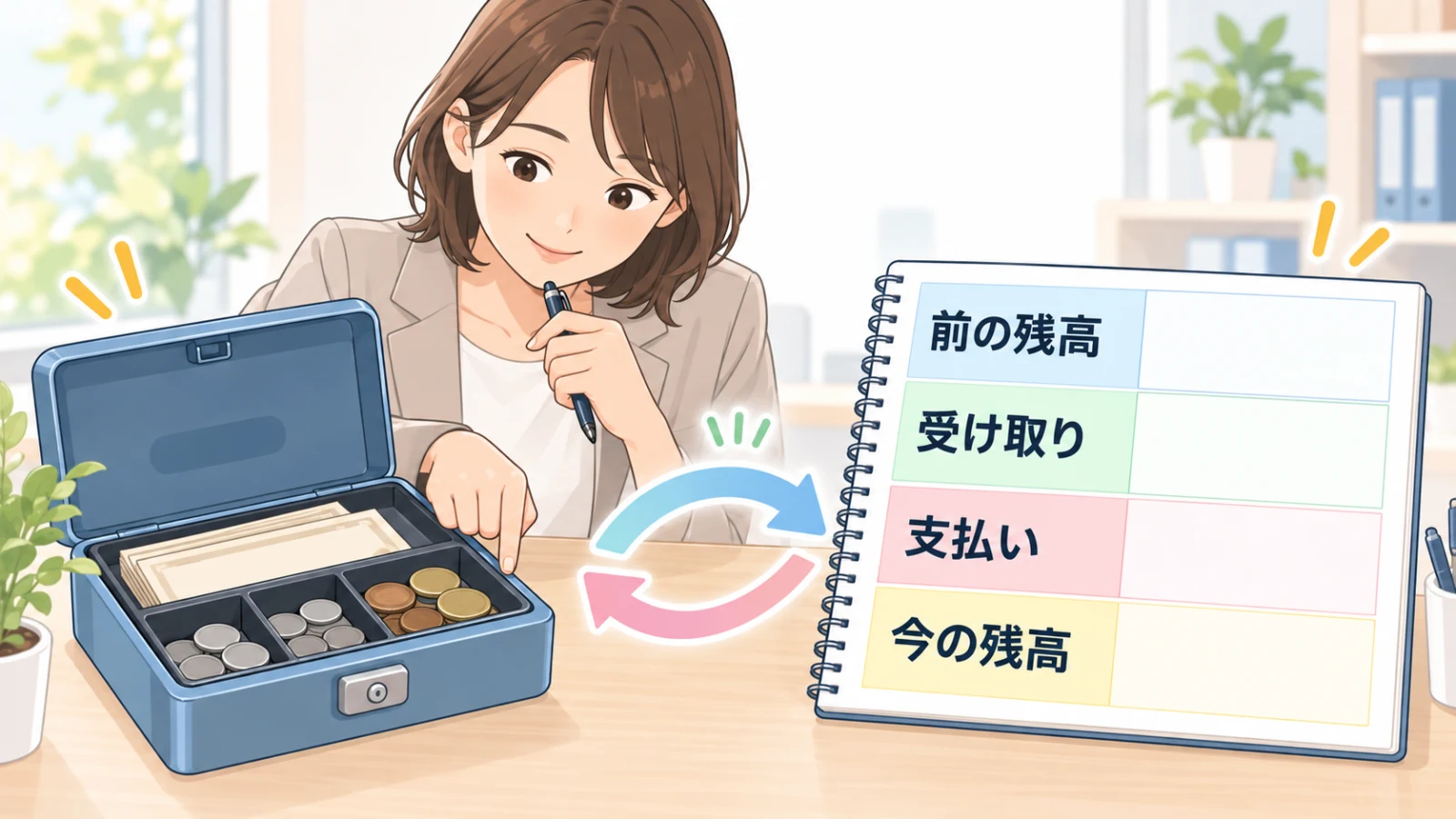
What the diagram shows: Do not judge solely by the current money; instead, connect and verify the records of receipts and payments from the previously confirmed balance.
Linking receipts and entries to the same payment
A fictitious entry example is: "Payment Date: Today. Amount: 400 yen. Purpose: Office supplies. Responsible: Reception staff. Receipt: Today's example number B. Confirmation: Reconcile at closing." The amount is an example and does not represent actual company expenses or results. Having a receipt number or location allows you to trace back from the record to the original content.
If the person making the payment and the person recording it are different, decide when and to whom the receipt should be handed over. If it cannot be handed over by closing time, record that there is an unrecorded payment. This is to reduce reliance solely on the memory of the person in charge.
Confirm with the internal accounting staff how to avoid mixing funds for later reimbursement, or provisional funds to be finalized later, with regular payments. If they are categorized together just because money was disbursed, it becomes difficult to know if refunds or settlements have been completed.
Check discrepancies in order from the last matching date.
First, find the date when the cash and records last matched. Then, for subsequent receipts and payments, cross-reference records and receipts one by one. Check for omissions, duplicates, misread amounts, and dates before/after closing. By not expanding the confirmed range too much and segmenting it sequentially, oversights are easier to notice.
Next, recount the cash. Separate coins and banknotes by denomination and record the counting results. If possible, have another person confirm it. Also, check the totals in the records, including additions, subtractions, and column ranges. Even when using spreadsheets, check for empty cells or shifts in the aggregation range.
If the cause is still unknown, confirm specific payments with the person in charge. Don't just ask "Did someone use it?", but inquire by indicating the date, receipt, and possibility of it being unrecorded. Once the cause is found, record the state before and after correction, the reason, and the person who confirmed it.
A small question
The cash on hand is 400 yen less than the ledger, and there's an unrecorded receipt on the desk. Can I record this as a payment to cover the discrepancy?
Check if that receipt is for a payment made from petty cash during the same period, or if it has already been entered into another record. Matching amounts alone does not determine the cause. If the fact of payment and omission of entry are confirmed, follow the workplace's correction procedures.
If it's a receipt for a personal advance or payment from a different wallet, do not use it to fill the petty cash discrepancy. If the cause remains unresolved, record the discrepancy and confirmed details, and seek accounting's judgment.
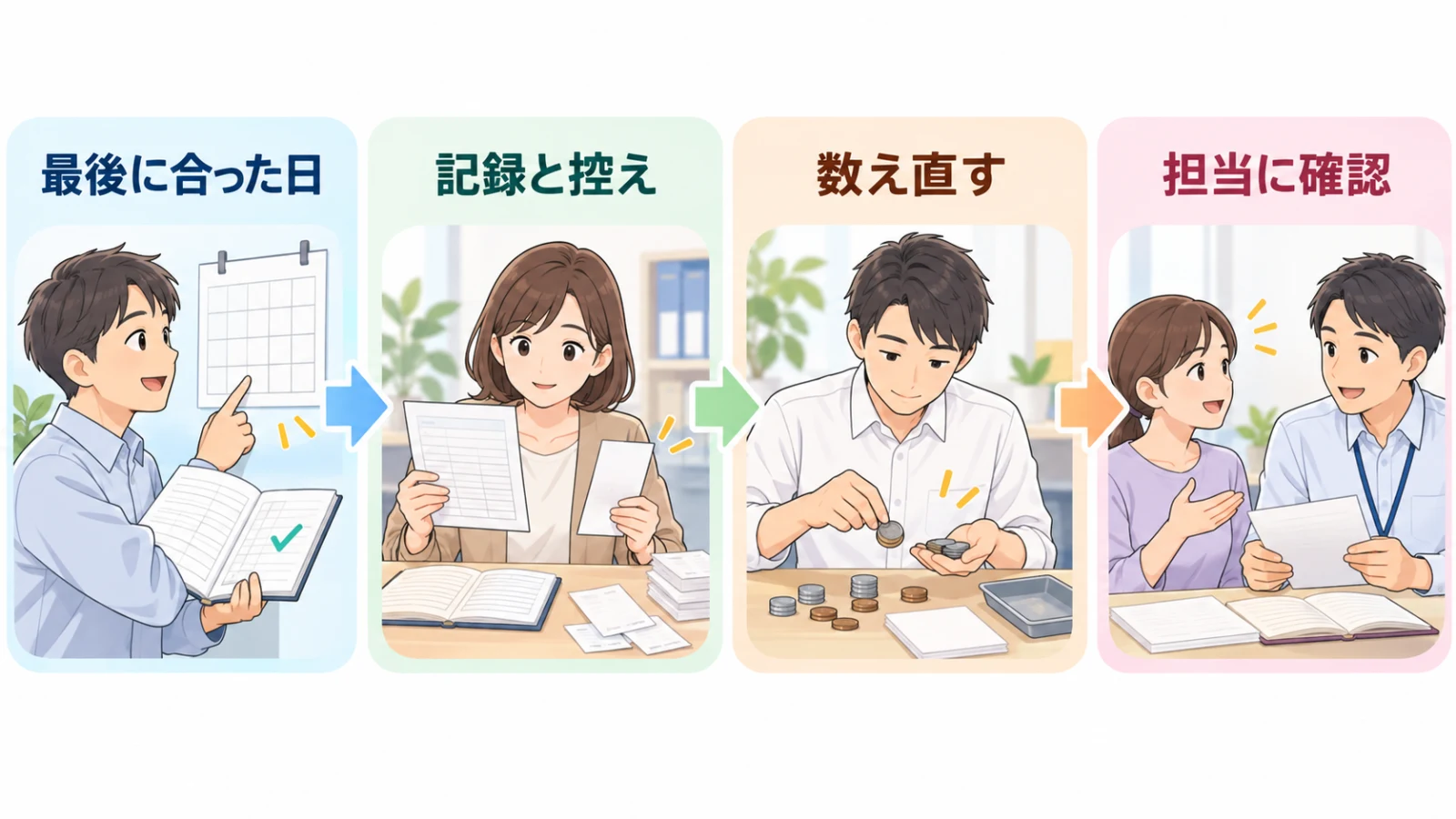
What can be understood from the diagram: Before reconciling the discrepancy, we sequentially check records, receipts, and cash, starting from the date of confirmation. If the cause is unknown, we document the scope that has been checked and pass it on to the person in charge.
Even if amounts match, it doesn't necessarily mean it's the same payment.
Let's consider a scenario where an unrecorded receipt is found. Upon asking the person in charge, it was found that the payment was personally advanced and not yet reimbursed. In this case, if the receipt is entered as a petty cash payment, it would make it seem as if money that wasn't actually spent was spent.
What we want to confirm is who paid from which funds, when it was settled, and if it was already recorded. Instead of just looking at the receipt amount, go back to the money movement. Confirming discrepancies and settling advances should be handled as separate tasks with the accounting staff.
Conversely, if it's confirmed that a payment was made from petty cash and it was an omission, record that payment correctly. In addition to the discrepancy being resolved, leave a record so that it's clear later why the correction was made. It's important to distinguish between confirmed resolutions and payments that still require confirmation.
When changing personnel, confirm cash and incomplete records together.
When changing personnel, count the cash together and reconcile it with the ledger balance. If there are unrecorded receipts, unsettled advances, or discrepancies whose causes are being investigated, list them separately. Simply showing the location of the safe or box does not transfer ongoing work.
Define the roles of the person managing, the person verifying when used, and the person confirming the closing. Even if there are few people and roles are combined, consider methods for another person to regularly check records and cash. Aim for a system where both payments and verifications don't stop just because one person is absent.
If a discrepancy is handed over unresolved, record the amount, the scope of verification, and the next person to ask and the date. Do not silently adjust it to the new person's initial balance; instead, ensure the new person receives it with clarity on where the unresolved issue begins.
For discrepancies with unknown causes and for retention documents, confirm with the person in charge.
The handling of discrepancies with unknown causes should not be decided based solely on this example. Provide the facts and confirmed records to the accounting staff or the person responsible for making decisions. Filling it with personal funds or adding non-existent expenses will make it impossible to explain the money movements.
Some documents, such as receipts and cash ledgers, require retention. Do not discard originals just because you've photographed them or transcribed amounts into a table; confirm the adopted retention method. For records of transactions received electronically, also ensure the original data is preserved. Official guidance and confirmation dates are listed in the references.
If the number of petty cash transactions is high and collecting receipts is burdensome, you can choose to review the use of cash itself. However, changing payment methods will also change who can use them and the settlement procedures. Try it only after confirming conditions that ensure on-site payments do not stop.
Verify a single instance with the cash book template and reconciliation tool.
The reconciliation tool below compares the previous balance, receipts and payments from then until now, and the actual cash counted. In a fictitious example, 10,000 yen is added to 5,000 yen and 2,400 yen is subtracted, so the ledger balance is 12,600 yen. If the cash on hand is 12,200 yen, the discrepancy will be minus 400 yen (actual minus ledger).
Even if a discrepancy occurs, finding a receipt with the same amount alone does not determine the cause. Cross-reference the period, the wallet from which it was paid, and whether it has already been recorded. The tool helps calculate four amounts; it does not judge the correctness of records or the cause of discrepancies.
If you continue to record, you can use the free cash book template. The entry version calculates the balance from the initial balance and daily receipts/payments, with separate fictitious entry examples and usage instructions. The denomination sheet is an aid for counting the number of banknotes and coins. Align the counting date and the target wallet, and check for any remaining empty fields before reconciling.
Do not mix receipts and payments on one line; assign a receipt number to each movement. Do not use it to directly rewrite the balance calculation field to eliminate discrepancies. Please confirm document retention methods and accounting procedures with workplace rules and the person in charge.
Free / No registration required
Petty Cash Book & Denomination Table Template
Usage, entry form, fictional example, and denomination table. Includes balance calculation formulas.
Save spreadsheet file (.xlsx)You can save and edit this in spreadsheet software. Please modify it to match the items used in your workplace. Revised: October 18, 2026.
Reconcile petty cash balance
Calculate the book balance by adding receipts and subtracting payments from the last confirmed balance for the same period.
Please enter the amount for the same period and the same wallet. Enter as an integer (yen) using half-width numbers. You can also enter 0 yen. Each amount must be 999,999,999 yen or less.
Enter in half-width numbers (e.g., 1200)
Enter in half-width numbers (e.g., 1200)
Enter in half-width numbers (e.g., 1200)
Enter in half-width numbers (e.g., 1200)
This week, reconcile one closing with another person in charge.
For one closing, please check the previous balance, receipts, payments, receipts, and current cash in order. You can start by linking any item that couldn't be traced back from the record to its receipt using its number or location.
After confirmation, record not only whether there was a discrepancy but also what was checked to confirm it. If the next day's person in charge can explain it in the same order, it will gradually reduce confusion during daily closings and personnel changes.
Key points of this article
- Reconcile cash and records from the same point in time, starting from the last matching date.
- Even with receipts where amounts match, verify the money movement.
- Do not fill unresolved discrepancies without reason; hand over the confirmed scope to the person in charge.


