Summary
Key points of this document
- Why Does Website Improvement Become a Mere Formality? The Structural Flaws of "Intuition and Sporadic Measures"
- Funnel-Specific Quantitative Observation Metrics: Integrated Design of Search Console and GA4
- A scientific framework for deriving prioritized improvement plans from bottlenecks
Overview
Common challenges in website operations are "sporadic measures based on intuition and whims" and "organizational silos where code modifications don't progress despite reports being viewed." We explain the design and operational practices of a "Scientific Growth Loop" that applies quantitative data from Google Search Console and GA4 to a funnel structure, identifies exit points, and then completes hypothesis formulation, component modification, deterministic verification, and production deployment in short cycles. This initiative serves as a technical foundation that sustainably supports both stimulating prospective customer interest (acquisition) and forming a pool of candidates that align with the organizational culture (recruitment).
Why Does Website Improvement Become a Mere Formality? The Structural Flaws of "Intuition and Sporadic Measures"
In many website operations, improvements often fall into the state of 'completely overhauling every few years because the design is old' or 'installing an analytics tool but only observing monthly PV fluctuations.' Even if these appear to be continuous operations, in reality, a 'closed feedback loop of improvement' is not functioning.
The biggest structural factor causing this formality is the division between 'personnel who perform measurement and analysis' and 'implementers who modify the site's code and content.' Even if monthly reports list issues like 'high bounce rate' or 'decreased views on specific pages,' concrete fixes to resolve them (optimization of titles and meta elements, improvement of UI first view, redesign of internal links) are not seamlessly connected, causing improvement to halt at the point of report submission.
Furthermore, if the formulation of measures depends on the subjective judgment of the person in charge, the verification of results is not done quantitatively, and neither success factors nor failure factors remain as organizational knowledge. To solve these issues, an engineering approach is needed that defines measures by reverse-calculating from measurable quantitative indicators and iteratively implements and deploys to production in short cycles.
- Division of Analysis and Implementation: When those who create reports are separate from those who change code, improvement actions are often shelved without being executed.
- Limitations of Subjective Measures: Comprehensive overhauls not based on quantitative bottlenecks are unlikely to contribute to results relative to the effort invested.
- Need for a Closed Loop: An operational foundation is needed where quantitative observation → bottleneck identification → hypothesis formulation → implementation/verification → re-measurement are seamlessly linked.
Funnel-Specific Quantitative Observation Metrics: Integrated Design of Search Console and GA4
The first step to running a scientific improvement cycle is to model the process from when a user discovers a website to their final action (inquiry or application) as a funnel, and define measurement metrics corresponding to each stage.
Specifically, we observe the 'external funnel (Search Console)' from search engine to site arrival and the 'internal funnel (GA4)' from site arrival to action completion, combined as follows:
- Stage 1 [Discovery/Exposure]: Google Search Console Impressions, Average Position, and number of valid indexed URLs. Measures search intent (real-world problem queries) and site suitability.
- Stage 2 [Reach/Click]: Search Console Clicks and Search Result Click-Through Rate (CTR). Affected by the specificity of titles and descriptions, and clarity of headings.
- Stage 3 [Viewing/Engagement]: GA4 External Inflow Sessions, Average Engagement Time, and Scroll Rate (90% completion). The immediacy of answers in the first view and the comprehensiveness of the article affect the bounce rate.
- Stage 4 [Interest/Navigation]: Internal link click-through rate, PV per session, and transition to related topics. Measures whether users are prevented from leaving after a single article and are navigating related knowledge within the domain.
- Stage 5 [Action/Conversion]: Consultation/application form reach rate, input start event (consultation_start), submission complete event (consultation_submit_success).Scientific Framework for Deriving Prioritized Improvement Plans from Bottleneckssubmit_success)。
// Example type definitions for GA4 custom events and funnel tracking using TypeScript
/**
 * Type definition for funnel tracking events
 * Tracks state transitions from external sessions to form submission completion
 */
export type FunnelStage =
  | 'discovery'      // Search Console: Search exposure and clicks
  | 'reading'        // GA4: Article body engagement
  | 'cluster_nav'    // GA4: Navigation within a topic cluster
  | 'cta_click'      // GA4: Call-to-action click
  | 'form_start'     // GA4: Input form start (consultation_start)
  | 'form_complete'; // GA4: Submission complete (consultation_submit_success)

export interface ConsultationTrackingPayload {
  contact_type: 'it' | 'recruit';
  source_article_slug?: string;
  source_cluster_id?: 'excel' | 'storage' | 'manual' | 'tools';
  measurement_version: 'contact-v2';
  scroll_depth_percent?: number;
}

export function trackFunnelEvent(
  stage: FunnelStage,
  payload: ConsultationTrackingPayload
): void {
  if (typeof window === 'undefined' || !window.gtag) return;

  window.gtag('event', stage, {
    ...payload,
    event_timestamp: new Date().toISOString(),
    traffic_scope: 'external',
  });
}
A scientific framework for deriving prioritized improvement plans from bottlenecks
Once quantitative data is available, we compare the latest week's figures with the previous week's and target values to identify where the biggest drop-offs (bottlenecks) occur in the funnel. Improvement measures are formulated not as mere ideas, but as hypotheses stating 'which metric to move, why, and how.'
For prioritizing measures, we apply a priority matrix using the product of 'Affected Population (Volume) × Room for Improvement (Gap) × Implementation Feasibility.' For example, improving the CTR of a main page displayed 1,000 times a month by 2% has a greater impact on the population than doubling the CTR of a page displayed only 10 times a month.
- Optimizing search exposure (expanding the audience): For articles with search volume but stagnant impressions, we re-adapt titles and descriptions to specific on-site search terms (e.g., concrete business problems rather than conceptual phrases) and apply structured data (JSON-LD) to help search engines understand their meaning.
- Preventing bounce by providing immediate answers in the first view: Readers arriving from search decide within the first few seconds whether the page contains the answer they seek. Placing conclusions or summary overviews at the beginning prevents pogo-sticking (immediately returning to search results), extends dwell time, and promotes stable search rankings.
- Ensuring navigability through topic cluster networks: A parent article (pillar article) and multiple detailed child articles are interconnected with mutual links, presenting systematic information on a specific field to both readers and crawlers.
- Reducing conversion rate (CVR) friction: To prevent abandonment after reaching a form, we clearly state that no prerequisite materials are needed and explain how the initial consultation proceeds, adopting a design that minimizes required input fields.
// Example implementation for generating Article Structured Data (Article JSON-LD) using TypeScript
/**
 * Generates Article Structured Data (JSON-LD) for search crawlers.
 */
export function createArticleJsonLd(article: {
  title: string;
  description: string;
  publishedAt: string;
  updatedAt: string;
  url: string;
  imageUrl: string;
}) {
  return {
    '@context': 'https://schema.org',
    '@type': 'Article',
    headline: article.title,
    description: article.description,
    datePublished: article.publishedAt,
    dateModified: article.updatedAt,
    mainEntityOfPage: {
      '@type': 'WebPage',
      '@id': article.url,
    },
    image: [article.imageUrl],
    author: {
      '@type': 'Organization',
      name: 'Example Team',
    },
  };
}
SSG and Deterministic Verification Pipelines for Fast and Secure Improvement Implementation
Even if an improvement plan is decided, if it takes several weeks from implementation to production deployment, the hypothesis testing cycle will slow down. To safely and reliably deploy weekly improvements, a continuous delivery foundation with Deterministic Checks is essential.
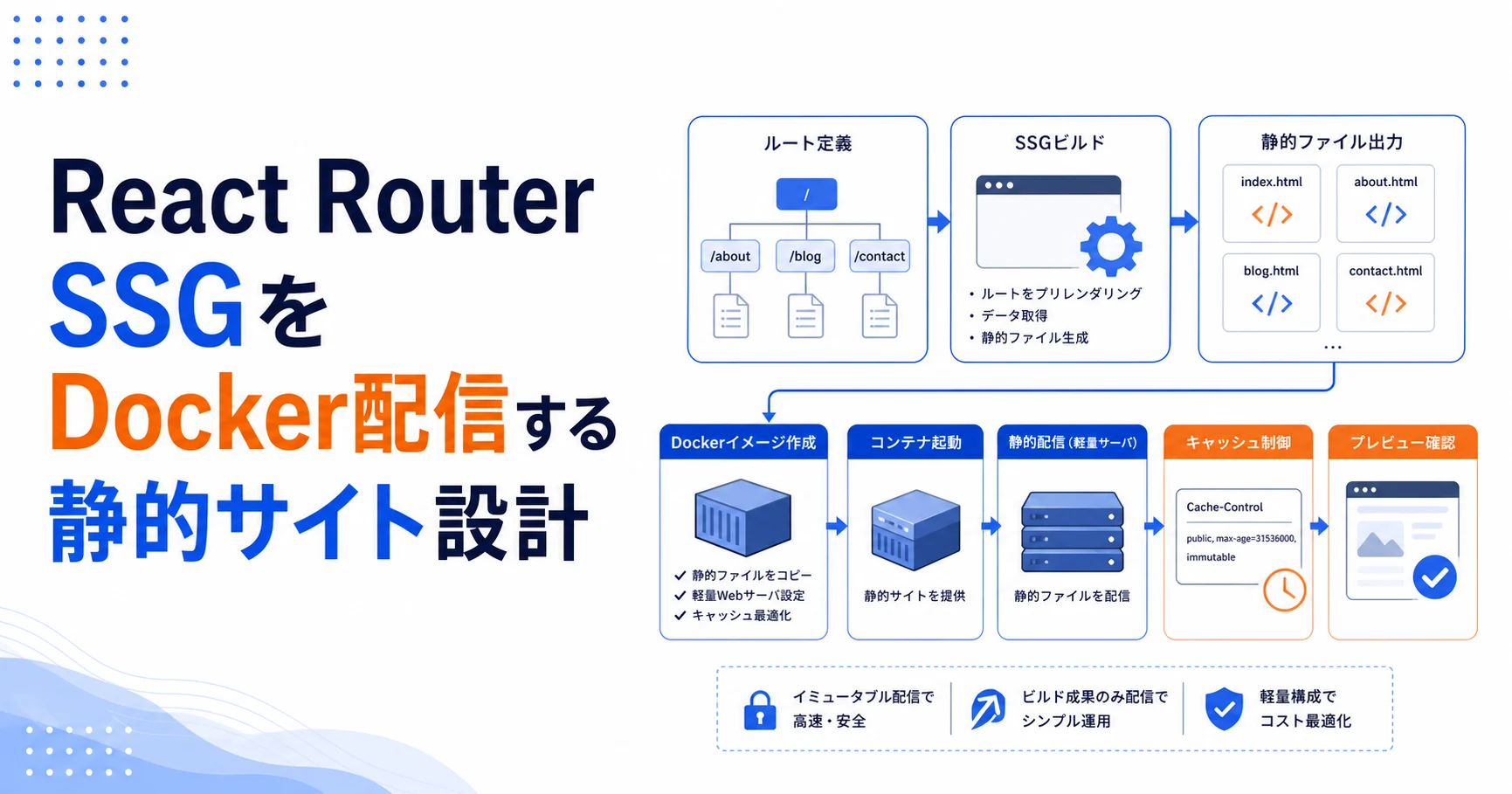
Directly editing articles ad-hoc in a dynamic CMS's admin screen often leads to human errors such as layout breakage, broken links, or incorrect meta tag settings. In this architecture, content and UI components are centrally managed as code (TypeScript / React Router / SSG) in a repository, and automated verification scripts are run during the build process.
- Ensuring completeness with type checking (tsc): Detects at compile time if article data models, cluster definitions, or metadata types are broken.
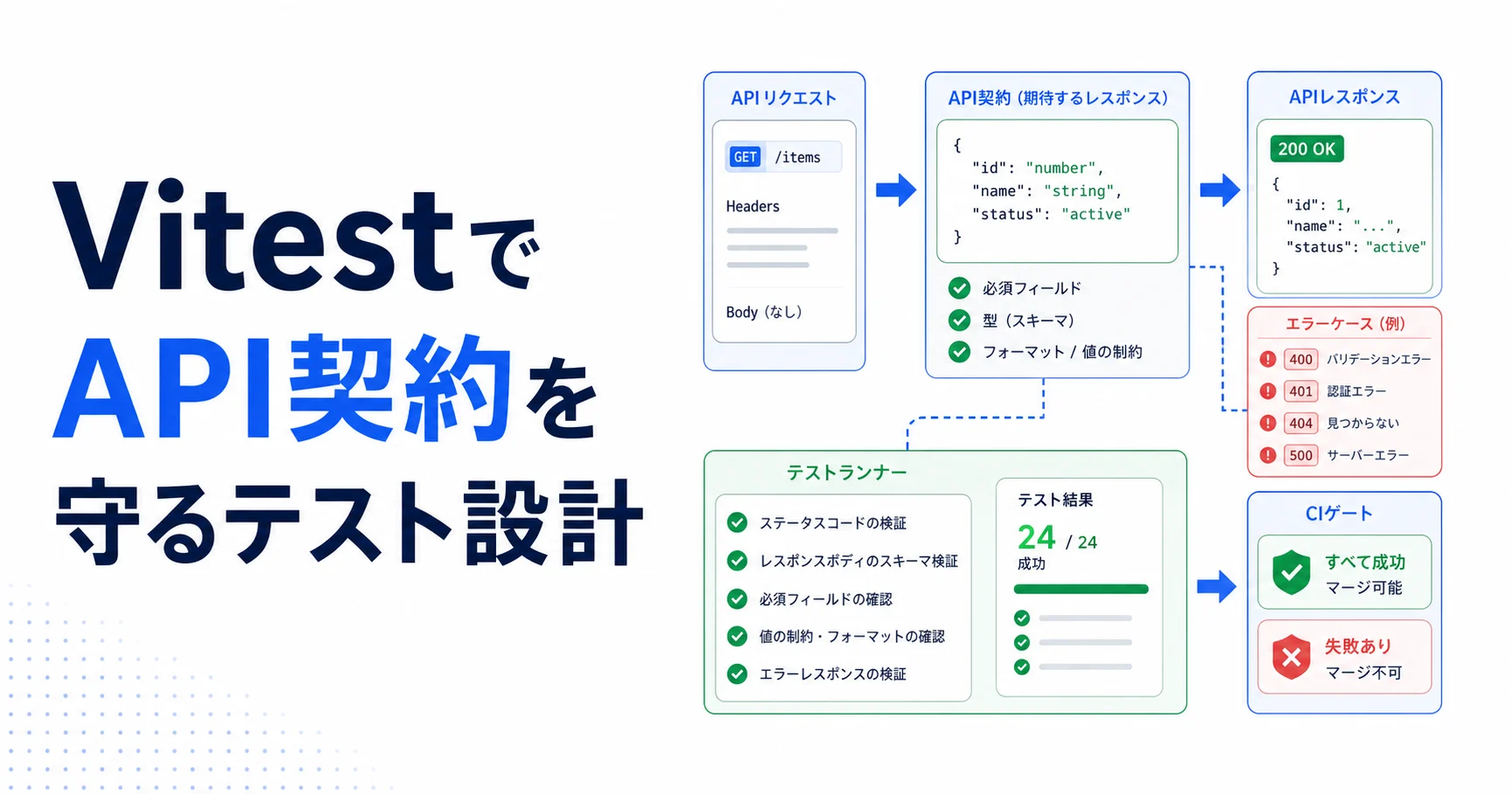
- Unit and contract tests (Vitest): Automatically tests article loading pipelines, internal link generation logic, and query tracking parameter retention processes.
- Full static SEO validation (check-seo.mjs): Scrapes and inspects all HTML files generated by SSG build to mechanically verify 100% canonical URL consistency, title/description character count rules, JSON-LD syntax validity, and OGP image existence.
- Production API liveness monitoring: Automatically verifies that inquiry and recruitment APIs (CORS preflight, 422 validation, acceptance endpoints) respond normally before and after deployment.
// SEO verification script for all pages after SSG build (part of check-seo.mjs, generalized code)
// Automatically verifies all generated static HTML files
import fs from 'node:fs';
import { parse } from 'node-html-parser';

function validateHtmlPage(filePath, expectedBaseUrl = 'https://example.com/') {
  const content = fs.readFileSync(filePath, 'utf-8');
  const root = parse(content);

  // 1. Check for canonical tag existence and domain matching
  const canonical = root.querySelector('link[rel="canonical"]')?.getAttribute('href');
  if (!canonical || !canonical.startsWith(expectedBaseUrl)) {
    throw new Error(`Invalid canonical in ${filePath}: ${canonical}`);
  }

  // 2. Check for title / description existence
  const title = root.querySelector('title')?.text;
  const description = root.querySelector('meta[name="description"]')?.getAttribute('content');
  if (!title || !description) {
    throw new Error(`Missing SEO meta tags in ${filePath}`);
  }

  // 3. Validate JSON-LD syntax
  const jsonLdScripts = root.querySelectorAll('script[type="application/ld+json"]');
  for (const script of jsonLdScripts) {
    JSON.parse(script.text); // Throws an exception if there's a parsing error
  }
}
Impact and Measurement of Quantitative Improvements on User Behavior (Customer Acquisition & Recruitment)
The continuous effort to systematically publish and improve our problem-solving processes and technical knowledge through a scientific growth loop brings measurable positive effects on both the quality and quantity of site visitors' actions (customer inquiries, job applicant submissions).
This is because both prospective customers and job seekers considering applying share a common need for information to make decisions from a company's public information: 'What kind of technical capabilities and integrity does this team bring to solving daily challenges?'
- Measurement impact on customer acquisition: By disclosing specific on-site challenges (e.g., redundant data entry, scattered documents, ritualized procedures), their root causes, and engineering solutions, readers can properly organize their own challenges. As a result, inquiries with clear backgrounds and objectives become more frequent, improving the precision of initial communications.
- Measurement impact on recruitment: By disclosing technical documents and improvement processes themselves—showing how quantitative analysis is actually performed and what architecture ensures continuous delivery, rather than abstract PR statements—the development culture and technical standards are concretely conveyed, leading to applications from candidates whose skills and values align with what is sought.
- Accumulation of Intellectual Assets: Unlike traffic from temporary publications, technical documents and business improvement know-how continuously improved through scientific growth loops function as permanent assets that are continuously referenced both internally and externally, including by search engines.
Operational Sustainability: Regular cycling and operational structure design
The barrier often faced in web improvement is not the planning of measures, but rather 'maintaining an operational process that continuously cycles through regular measurement, analysis, and improvement implementation.' If analysis and code modifications are postponed due to the ebb and flow of regular work, the improvement cycle can easily stagnate.
To establish this cycle, it is crucial to incorporate regular meetings for reviewing periodic reports and selecting priority backlogs on a weekly or sprint basis, and to establish a development rhythm that continuously deploys while keeping the scope of changes small.
To prevent your website from remaining a static deliverable and instead continuously improve it based on data, start by observing recent metrics and identifying one bottleneck in your funnel.
- Establishing an Operational Rhythm: Prevent improvement stagnation by combining weekly reviews with small, continuous deployments.
- Note (Operational Structure Options): The series of cycles—analysis, planning, implementation, and verification—explained in this article can be applied not only to in-house operations by internal teams but also to continuous support systems such as monthly accompaniment plans by external partners.
- First Step Starting with Measurement: The initial step is to check high-exposure search queries in Search Console and reflect concrete solutions at the beginning of the corresponding content.