
Summary
Key points of this document
- 1. Background and Challenges: Why 'Merge-Time Checks' Alone Lead to System Degradation
- 2. Evolution from DevOps to Continuous DevSecOps: The Role of AI Task Scheduler
- 3. Cost Optimization and Robustness Assurance through 'Multi-Axis Evaluation' beyond Security
Overview
In automated pipelines for software development, static analysis, automated testing, and vulnerability scanning triggered by Pull Requests (PRs) or merges to the main branch are widely established. However, event-driven quality gates that inspect only at the moment of change cannot prevent the phenomenon where running systems silently degrade over time.
This article explains the operational architecture and design decisions for 'Continuous DevSecOps,' which uses an AI agent-based task scheduler as a second line of defense to complement traditional merge-time gates, autonomously executing multi-axis audits weekly or monthly and continuously creating structured issues.
1. Background and Challenges: Why 'Merge-Time Checks' Alone Lead to System Degradation
System health does not remain in its post-release state indefinitely. Even during periods when no code changes are made, the external environment surrounding the system and the state of the execution platform are constantly changing.
Factors of degradation over time (Software Entropy and Drift)
Publication of new vulnerabilities (CVEs):
Cases where serious CVEs are published weeks or months later for dependency libraries or container base images that had zero known vulnerabilities at the time of merge occur daily. Since CI pipelines do not trigger in repositories without changes, vulnerabilities are easily left unaddressed.
Configuration Drift and Privilege Bloat:
During troubleshooting or emergency validation, cloud resource configuration changes or temporary relaxation of IAM permissions may be performed manually and remain in place without being reverted.
Residual unused resources and cost inflation:
After feature deprecation or experimental validation, isolated storage volumes, unnecessary snapshots, over-spec instances, and indefinitely accumulating log data remain, silently pressuring running costs.
Runtime and API Obsolescence:
Even as cloud service or external SaaS API deprecations or language runtime End-of-Life (EOL) approach, they are often overlooked in daily development flows.
Structural limitations of event-driven CI/CD
Event-driven CI/CD, which 'inspects only when code is changed,' is extremely effective for preventing regressions in new changes, but it is powerless against the degradation caused by the passage of time described above. The differences in roles between event-driven and time-driven approaches are shown below.
| Comparison Point | Event-Driven Gate (PR/Merge-time CI) | Time-Driven Audit (Periodic AI Audit) | Positioning in Mutual Complementarity |
|---|---|---|---|
| Trigger | Commit, PR creation, Merge | Weekly/Monthly periodic schedule | Covers both change-time and steady-state |
| Main Inspection Targets | Change diffs, unit/integration tests, syntax | Overall consistency, new CVEs, config drift, costs | Division of roles between local inspection and overall overview |
| Inactive Repositories | Inspection not executed | Inspection executed periodically | Detection of vulnerabilities/EOL in neglected systems |
| Nature of Judgment | Rule-based mechanical Pass/Fail | Multi-axis evaluation with context and prioritization | Balancing gate blocking and planned improvement |
| Output Destination | CI status, PR block | Automated creation/update of structured Issues | Natural integration into development backlogs |
2. Evolution from DevOps to Continuous DevSecOps: The Role of AI Task Scheduler
Traditional periodic scanning tools (such as vulnerability scanners) merely notify users with massive warning logs or alert emails, leaving the burden of checking for duplicates with existing issues and organizing remediation plans entirely to humans. As a result, it easily leads to 'alert fatigue,' where alerts are no longer read.
Here, by combining thetask scheduler function(periodic execution triggers and autonomous workflows) provided in current AI tool and agent platforms, auditing can be elevated from a notification task to a consistent engineering process integrated into the backlog.
Autonomous periodic execution:
The AI audit agent is triggered at fixed intervals, such as weekly or monthly, to cross-read target repositories, Infrastructure as Code (IaC) definitions, cloud configuration information, and dependency manifests.
Context understanding and continuous creation of structured issues:
Instead of simply transcribing detection logs, we structure them into Issues that clarify 'which file/resource is involved,' 'why it is a risk or inefficient,' 'what the severity level is,' and 'what the recommended remediation approach is.'
- Integration with DevOps Backlogs:
Rather than isolating security and cost improvement tasks as a special category, we feed them into the same Issue tracker (such as GitHub Issues) used for regular feature development, allowing the development team to naturally address them during sprint planning.
3. Cost Optimization and Robustness Assurance through 'Multi-Axis Evaluation' beyond Security
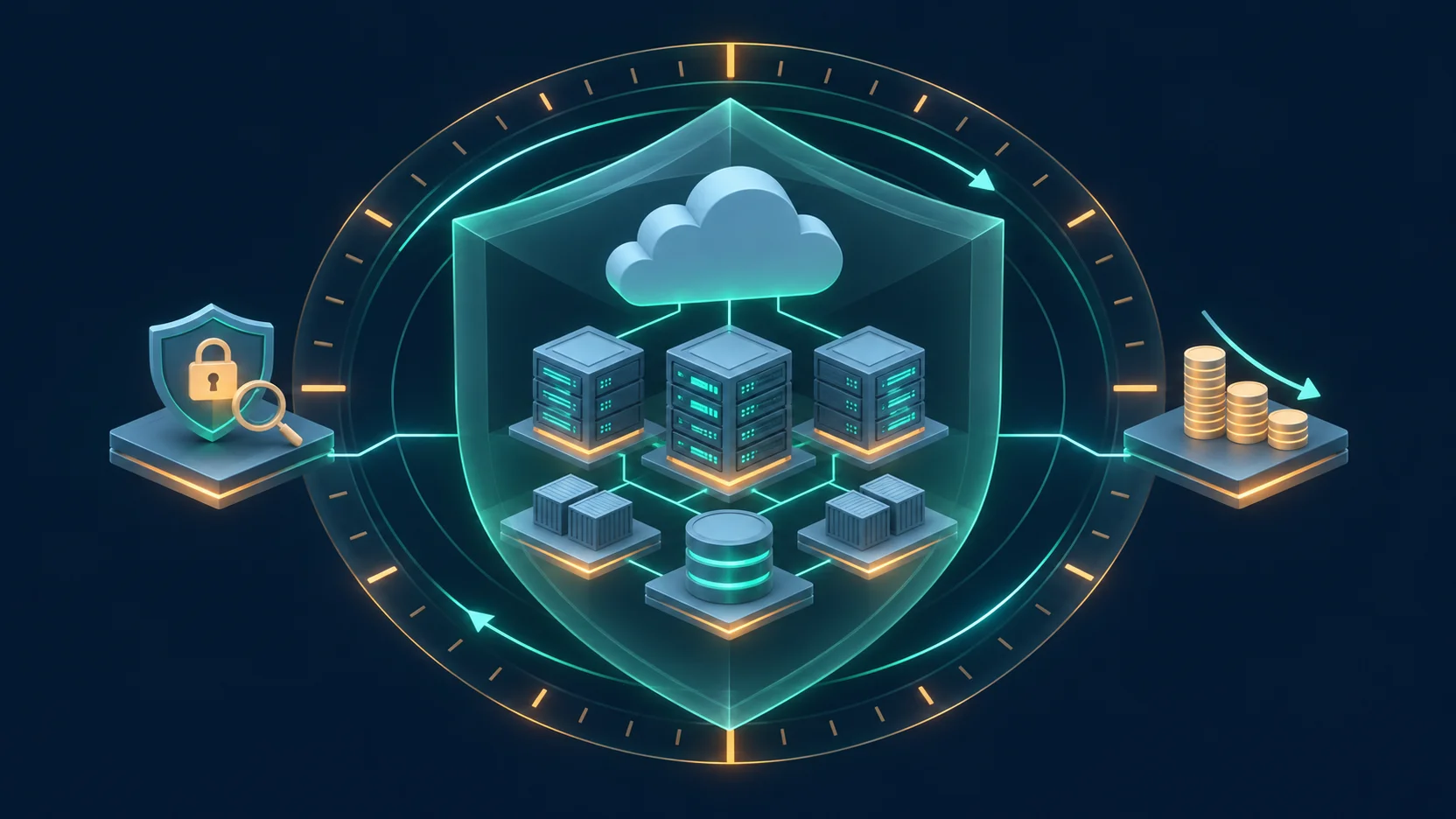
It is a waste to limit time-driven periodic audits to security checks only. Within the same loop where AI agents scan repositories and configuration definitions,Security, Cost, Code Hygiene, and Reliabilityby comprehensively inspecting these four evaluation axes, we can continuously guarantee a 'cost-optimized' and 'robust' system state.
- Security and Authorization Boundary Audit
- Cross-referencing new CVEs against dependency packages (npm, Go modules, Python, etc.) and container images.
- Re-inspecting source code and configuration files for leaked secrets or API keys.
- Checking for excessive permissions in access control rules (Security Rules, IAM policies, RBAC definitions) and the presence of authentication/authorization bypass paths.
- Cost Optimization and Resource Hygiene Audit
- Identifying orphaned resources without references (unused storage, disconnected IP addresses, old build artifacts).
- Evaluating excessive instance specs relative to actual load and the validity of auto-scaling minimum settings.
- Risks of unlimited storage bloat due to missing log retention periods, and pay-as-you-go spikes in external API calls or AI token consumption.
- Code and Dependency Hygiene Audit
- Deprecated warnings for external SDKs or cloud APIs, and approaching EOL for runtimes (Node.js, Python, Go, etc.).
- Unreachable code, remnants after feature flag removal, and factors causing extreme delays in test suites or build pipelines.
- Reliability and Configuration Drift Audit
- Missing timeouts, retries (exponential backoff), circuit breakers, or fallback processing in external communications.
- Omissions in monitoring alerts, health checks, and database backup/restore verification settings.
- Unintended discrepancies in IaC definitions or environment variable schemas between staging and production environments.
The matrix below organizes the inspection targets and recommended cycles for each evaluation axis.
| Evaluation Axis | Main Inspection Targets | Recommended Cycle | Expected Effect |
|---|---|---|---|
| Security/Authorization Boundary | Dependency CVEs, IAM/Access Control Rules, Secret Leaks | Weekly (Daily for high risk) | Early containment of new vulnerabilities and blocking of breach paths |
| Cost Optimization/Resource Hygiene | Unused resources, log retention, instance size, usage caps | Monthly (Weekly for billing monitoring) | Suppression of unnecessary fixed/usage costs and prevention of unexpected billing |
| Code/Dependency Hygiene | EOL runtimes, deprecated APIs, dead code, CI execution time | Monthly | Prevention of technical debt accumulation and distribution of large-scale upgrade loads |
| Reliability/Configuration Drift | Timeout/retry settings, backup settings, environment differences | Bi-weekly to Monthly | Prevention of cascading failures and elimination of defects due to environment differences |
4. Processing Flow and Duplicate Suppression Mechanism for Periodic Multi-Axis Audits
To make periodic audits functional in actual operations, it is essential to design a process that includes cross-referencing with existing open Issues and triage, rather than simply creating Issues for every detected event.
Example of Structured Issue Output Template
To ensure developers can start working without investigation costs, every created Issue must include 'Target Location,' 'Rationale,' 'Scope of Impact,' 'Recommended Action,' and 'Completion Criteria' in a standardized format.
## [Audit][Cost/Security] Audit Summary Title

- **Evaluation Axis**: Cost Optimization / Security / Reliability / Code Hygiene
- **Severity**: High / Medium / Low
- **Detection Cycle**: 2026-11 Regular Audit
- **Target Location**: `infra/storage.tf` (Line 42-58)

### Detection Details and Rationale
The log storage bucket is configured without a lifecycle policy (automatic deletion/archive migration), leading to indefinite accumulation in standard storage.

### Anticipated Risks/Impact
Infrequently accessed historical audit logs will accumulate, causing monthly storage charges to increase linearly.

### Recommended Remediation Approach
1. Add a rule to migrate logs older than 90 days to a lower-frequency access tier.
2. Define a rule to automatically delete logs older than 365 days (or adjust according to legal retention periods).

### Completion Criteria (Acceptance Criteria)
- [ ] Lifecycle rules have been added to the IaC definition
- [ ] The application plan (Plan) for the staging environment does not result in unintended immediate deletion of existing data
Matrix for Noise Reduction and Safety Design
The biggest cause of periodic audits becoming a mere formality is noise caused by false positives or a large volume of low-priority Issues. The following safety measures are incorporated into the design.
| Safety/Noise Reduction Measure | Specific Control Rules | Purpose and Effect |
|---|---|---|
| Complete suppression of duplicate ticket creation | Before creating a ticket, check the title, target file, and rule ID of open Issues; if a match is found, only add a comment to the existing Issue | Prevents the same issue from proliferating as separate tickets every week |
| Severity filtering | Critical / High issues are created individually immediately, Medium or lower are aggregated into a monthly digest Issue, and Info levels are excluded | Reduces cognitive load on developers and maintains focus on critical tasks |
| Principle of read-only access | Grant AI audit agents only Read-Only access to repositories/cloud environments and permission to create Issues | Physically prevents production destruction or unintended automatic changes due to misjudgment |
| Exclusion/suppression list management | Explicitly state intentionally permitted configurations (accepted risks) in code configuration files or Issue labels to exclude them from future audits | Prevents the system from becoming a formality due to repeated reports of unnecessary warnings |
5. Limitations, Cautions, and Verification Perspectives
Continuous auditing using an AI task scheduler is a powerful mechanism, but the following limitations and cautions must be considered during implementation and operation.
1. Preventing Issue fatigue (alert fatigue)
If the act of creating tickets becomes the goal, hundreds of unresolved Issues will accumulate, leading the entire team to ignore notifications. It is desirable to set ticket limits (e.g., a maximum of 5 new tickets per execution, with the rest summarized) and implement automatic review rules for low-priority Issues left unattended for a certain period.
2. Permission boundaries and Human-in-the-Loop
While it is technically possible to configure AI agents to autonomously create fix PRs, direct changes to production environments or automatic merging must not be permitted. Especially for security settings, IAM permissions, database schemas, and resource deletions affecting billing, which require judgment on side effects and business impact, permissions must be limited to 'Read-Only Audit + Structured Issue Creation (or creating draft PRs for human review)', maintaining a boundary (Human-in-the-Loop) where final judgment and merging are handled by humans.
3. Maintenance of audit standards and effectiveness measurement
Audit prompts and evaluation checklists provided to the AI must also be maintained in line with changes in system configuration. After operation begins, regularly check the following quantitative indicators to tune audit accuracy.
- False Positive Rate: The percentage of created Issues closed as 'unnecessary/false detection'. If high, review the prompt's prerequisites or exclusion rules.
- Issue resolution rate and dwell time: How well created Issues are resolved within a sprint. If resolution is lagging, raise the severity threshold.
- Number of incidents and billing spikes: Whether failures due to neglected known CVEs or configuration drift, and unexpected billing due to unnecessary resources, have decreased after introducing periodic audits.
6. Conclusion: Decision axes for maintaining continuous health
From the moment development is complete and changes settle, systems begin to degrade due to changes in the external environment and configuration drift. It is difficult to detect and correct this 'silent degradation' using only event-driven gates at the time of merging.
By utilizing the task scheduler function of AI tools to run weekly/monthly periodic audits across the four axes of security, cost optimization, code hygiene, and reliability, and by feeding structured Issues that have undergone duplicate suppression and severity triage back into the development backlog, the following states can be achieved.
- Comprehensiveness independent of changes: New CVEs, EOLs, and configuration drift over time can be captured without omission for all running repositories and environments.
- Simultaneous optimization of security and cost: Vulnerability countermeasures and the reduction of unnecessary resources/excessive specs can be regularized through the same mechanism, preventing the expansion of operational costs.
- Elimination of personalization and safe control: A continuous DevSecOps system that does not rely on the memory or goodwill of individuals can be maintained under clear permission boundaries of Read-Only access and structured Issue creation.
Whether for small-scale services or enterprise infrastructure, incorporating a time-driven line of defense starting from the minimum configuration of 'Read-Only access + monthly 4-axis audit + Issue creation with duplicate suppression' is a realistic design decision that balances long-term system robustness and cost efficiency.


