
Summary
Key points of this document
- 1. Background and Challenges: Why directly connect a Linux server and Mac mini (8GB) with a wire?
- 2. Architectural Pillar 1: Gateway-less 1Gbps Wired Direct Connection and Single Cloudflare Tunnel Aggregation
- 3. Architectural Pillar 2: Management Daemon with "Exclusive Control + Idle Auto-Stop on No Communication" to Protect 8GB Memory
Overview
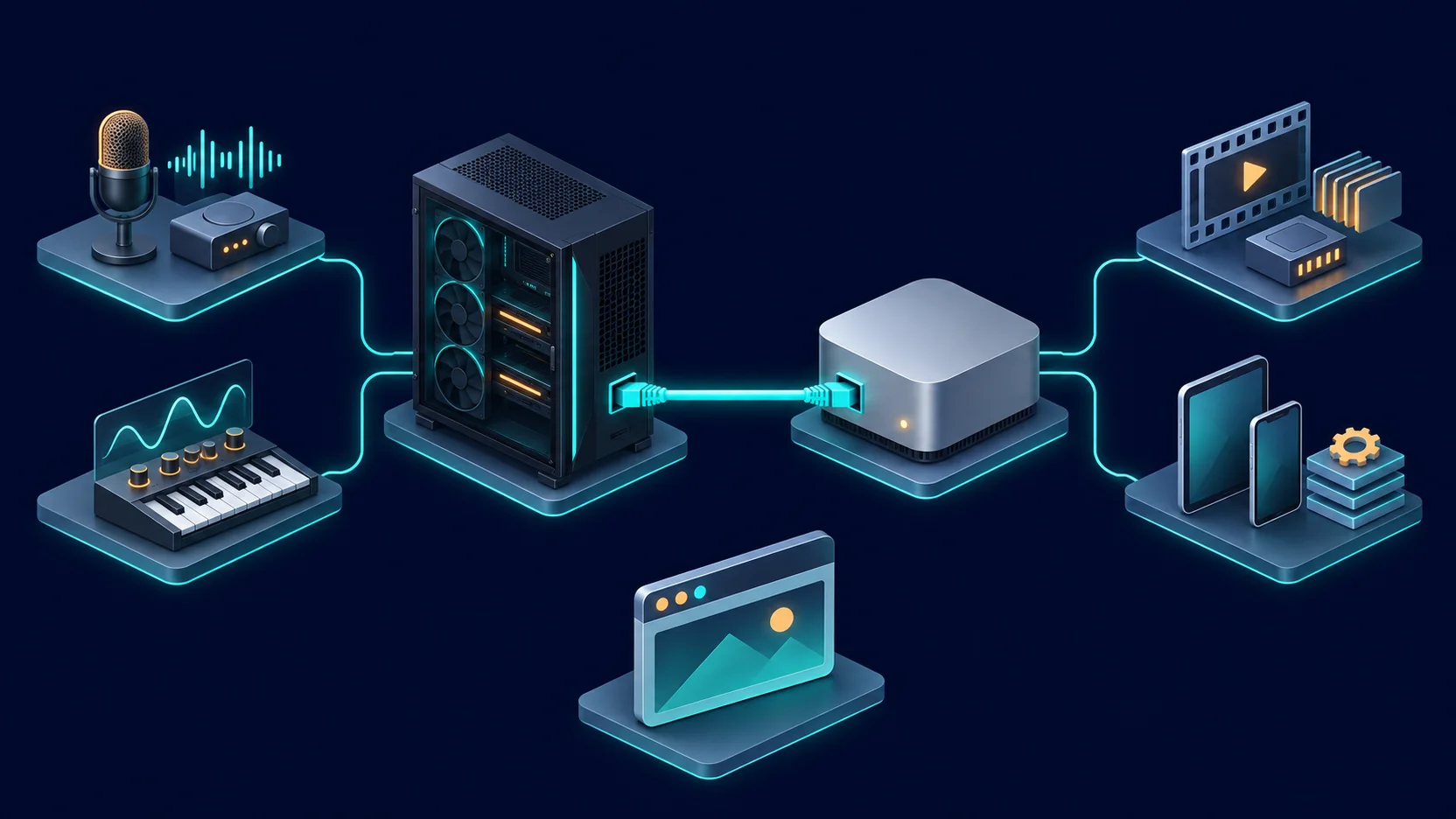
Linux Development Server × Mac mini Wired Direct Connection Architecture: Design to utilize 8GB Unified Memory as "External VRAM" for 4 roles + remote CDP browser.
While large language model (LLM) inference and parallel batch processing using GPUs are increasing on the Linux development server side, we explain a wired direct connection offload configuration to safely and stably utilize the computing resources and hardware acceleration of an Apple Silicon-equipped Mac mini (8GB Unified Memory) deployed as a secondary machine, without letting them idle. By combining single tunnel aggregation, an exclusive control daemon, and remote separation of Chrome DevTools Protocol (CDP), we organize the design decisions and operational standards to make the limited 8GB memory capacity function as effective "external VRAM".
1. Background and Challenges: Why directly connect a Linux server and Mac mini (8GB) with a wire?
In a configuration where processing is concentrated on the main Linux development server, two bottlenecks become apparent: GPU memory (VRAM) exhaustion and conflicts in browser automation.
Conflict between LLM inference and media/build processing:
If media-related workloads such as speech synthesis/recognition (TTS/STT), music generation, and video encoding are co-located while local LLM inference or parallel build/batch processing is running on the Linux side, contention for VRAM and system memory will occur.
Frequent swapping due to resident load on the 8GB Mac mini side:
On the other hand, if a secondary Apple Silicon Mac mini (8GB Unified Memory) is left with individual external tunnels, heavy integrated development environments (IDEs), and various resident utilities, most of the memory will be consumed by the OS and resident applications alone, leading to severe swapping and degraded responsiveness the moment inference models or video processing are launched.
Conflict between browser automation (MCP, etc.) and main Chrome:
When performing automated browser operations via AI agents or MCP (Model Context Protocol) on the Linux side, conflicts occurred with the profiles and process resources of the main Chrome browser used daily by developers, leading to the main browser becoming unresponsive.
To solve these issues, all unnecessary resident applications and individual tunnels were removed from the Mac mini, and it was directly connected to the Linux server via a dedicated 1Gbps wired link, redefining it as an "offload node dedicated to media processing, builds, and remote browsers."
2. Architectural Pillar 1: Gateway-less 1Gbps Wired Direct Connection and Single Cloudflare Tunnel Aggregation
By physically and logically separating external public access paths and internal inter-device communication, we achieve both reduced resident load on the Mac mini and stable communication.
Reasons for adopting a gateway-less dedicated subnet
The two machines are directly connected via an Ethernet cable, bypassing existing Wi-Fi or office routers, and are assigned a dedicated point-to-point subnet without a default gateway.
- Elimination of routing interference: By not having a default gateway, we prevent general internet traffic from mistakenly flowing to the direct link and mitigate the risk of being affected by Wi-Fi side route changes.
- Ensuring low latency and stable bandwidth: By isolating packet loss and latency fluctuations specific to wireless LAN, binary transfers of audio/video and CDP WebSocket communication are completed over a stable 1Gbps wired bandwidth.
Decision to consolidate into a single Cloudflare Tunnel
Previously, individual tunnel clients were also resident on the Mac mini side, but we consolidated the external entry point to a single Cloudflare Tunnel on the Linux development server side. Since traffic to the Mac mini is relayed from the Linux side's reverse proxy via the wired direct connection link, the number of resident processes and memory consumption on the Mac mini can be reduced, and TLS termination and access control policies can be centrally managed on the Linux side.
3. Architectural Pillar 2: Management Daemon with "Exclusive Control + Idle Auto-Stop on No Communication" to Protect 8GB Memory
Since it's impossible to run multiple heavy-duty workloads concurrently on 8GB of Unified Memory, we adopted a mechanism where a single lightweight HTTP API daemon exclusively switches between four roles and automatically releases processes when there is no communication.
Responsibilities and memory protection strategies for the four workloads
Each workload under the management daemon uses a combination of "on-demand startup + idle shutdown" and "immediate release upon job completion" depending on its processing characteristics.
voicemode (TTS / STT): Handles text-to-speech synthesis and speech recognition. Short-term residency is allowed to minimize model loading overhead, but the number of concurrent inferences is strictly limited, and if no communication is detected for a certain period, the worker process is stopped and memory is returned. Input/output is returned as audio binary or structured JSON.musicmode (music synthesis): Handles music generation such as BGM and sound effects.voicemode is mutually exclusive, and upon receiving a request, it stops existing voice-related workers before deploying the model. After generation is complete, it automatically stops via an idle timer.videojob (VideoToolbox-compatibleffmpeg): Executes video composition and transcoding utilizing Apple Silicon's hardware encoder (VideoToolbox). Accepted as an asynchronous job, and upon completion,ffmpegprocess and working memory are immediately released.ios-buildmode / job (xcodebuild, etc.): Executes iOS app builds and archives that require an Apple environment. Since memory consumption is the highest, other heavy resident workers are completely stopped before execution begins, and exclusive control is enforced to monopolize the entire system.
4. Architectural Pillar 3: Wired-Only, Public Key SSH, and CDP Remote Browser Separation
After removing the GUI resident load from the Mac mini, we implemented remote separation of CDP (Chrome DevTools Protocol) via SSH tunneling to allow agents on the Linux side to safely perform browser automation.
Security boundaries and operational separation points
SSH with wired interface only and public key authentication only:
The SSH daemon on the Mac mini is restricted to accept connections only from the directly wired interface, completely disabling password authentication and allowing only public key authentication. This blocks direct access to the control port from the Wi-Fi side or external networks.
CDP port not exposed externally:
The Chrome instance dedicated to automation running on the Mac mini restricts its debug port to local listening, equivalent to a loopback address, and is only connected to from the Linux side via SSH port forwarding. This design avoids directly exposing a plaintext CDP port on the directly connected subnet.
Complete isolation from the main browser:
Even if agents or E2E tests perform numerous tab openings/closings or heavy DOM parsing, these operations are confined within the dedicated Chrome on the Mac mini. This completely prevents issues such as the main Chrome on the Linux development environment being locked, or developer sessions and profiles being corrupted.
5. Architectural Pillar 4: Parallel Offload Effect as 'External VRAM (Unified Memory)'
The greatest advantage of this configuration is that it allows for role-sharing between the Linux GPU (VRAM) and the Mac mini's Unified Memory, enabling simultaneous execution of processes tailored to each hardware's characteristics.
Even when the Linux GPU is almost entirely occupied with VRAM for LLM-based code generation and text processing, agents can offload speech synthesis, high-speed video encoding with VideoToolbox, iOS builds, and browser operations for screen verification to the Mac mini in parallel via the wired link. As a result, the 8GB of Unified Memory functions as 'external VRAM dedicated to media, builds, and browsers' for the Linux server, significantly reducing overall development wait times.
6. Configuration Comparison, Workload Specifications, Trade-offs, and Verification Perspectives
Architecture Comparison Before and After Refresh (Markdown Table 1)
| Comparison Aspect | Before Refresh (Individual Resident, Standalone Operation) | After Refresh (Wired Direct Connection, Consolidated Offload) | Design Improvement Effect |
|---|---|---|---|
| External Exposure / Tunnel | Individual tunnels resident on each machine | Consolidated to a single Cloudflare Tunnel on the Linux side | Reduced Mac memory usage and centralized path management |
| Inter-machine Network | Via existing Wi-Fi / router | Gateway-less 1Gbps wired direct subnet | Lower latency and isolation from general traffic |
| Mac mini Resident Load | IDEs and various apps constantly occupy memory | Heavy resident processes abolished, only lightweight management daemons resident | Most of 8GB memory freed for computation and builds |
| Workload Control | Frequent swapping due to manual startup and concurrent execution | Exclusive control and idle shutdown via a single HTTP API | Prevention of OOM (out of memory) and swap degradation |
| Browser Automation | Conflicts with Linux main Chrome, leading to unresponsiveness | Remote control of Mac-dedicated Chrome via CDP over SSH | Ensuring stability and reproducibility of the main working environment |
4 Workload Exclusion Rules, Memory Release Strategies, and I/O Specifications (Markdown Table 2)
| Workload | Execution Form | Exclusion Rule | Memory Release Strategy | Main I/O Specifications |
|---|---|---|---|---|
voice (TTS / STT) | On-demand resident | Exclusive with other modes, limited concurrent inferences | Automatic stop upon communication idle timer expiry | HTTP JSON / Audio binary return |
music (Music Synthesis) | On-demand resident | On startup, voice etc. are stopped and switched | Automatic stop upon communication idle expiry after generation | HTTP JSON / Generated audio return |
video (VideoToolbox) | Asynchronous job | Stop existing resident workers and execute standalone | ffmpeg Memory immediately released upon termination | Job ID issuance / Completion notification・File retrieval |
ios-build (xcodebuild) | Asynchronous Job | Completely stops other heavy processes and occupies exclusively | Releases processes and temporary areas after build completion | Issues Job ID / Archives logs and artifacts |
Limitations and Trade-offs
This configuration is designed to overcome the 8GB hardware limitation through software control, so it must be operated under the following trade-offs and limitations.
Waiting time due to exclusive switching (no concurrent execution):
Due to memory capacity constraints,
voiceandmusic, orvideoandios-buildcannot be executed in parallel simultaneously. When switching modes, the preceding process stops and the next model reloads, resulting in a cold start delay of several seconds to tens of seconds.1Gbps Wired Link Bandwidth Limit:
Since the direct link is limited to 1Gbps (effective ~110MB/s), transfer time becomes a bottleneck for frequent transfers of large uncompressed video assets or build artifacts in GBs. A design where intermediate files are completed on the Mac mini side as much as possible and only final artifacts are transferred is effective.
Routing Design for Gateway-less Subnet:
If the priority (service order) of the Mac mini's management interface (for internet connection and OS updates) and the direct wired interface is incorrect, it will hinder name resolution and external communication. It is important to maintain a static design for the direct subnet, without setting a gateway, allowing only communication within a limited address range.
Verification Points During Introduction and Operation
To ensure that 8GB memory and communication isolation function as designed, the following three points will be continuously verified.
Checking for Swap Occurrence and Memory Pressure:
During peak execution of each workload and immediately after mode switching, measure
memory_pressureorvm_statand confirm whether evacuation to swap space is within acceptable limits and if free memory returns to initial levels after the idle stop timer.Verification of No-Communication Idle Auto-Stop Timer Operation:
voiceormusicrequests are completed, verify through automated tests or periodic monitoring that the target worker process reliably terminates after the specified no-communication time has elapsed, and returns to the minimal footprint of the management daemon alone.CDP Disconnection Recovery Verification:
When a temporary wired link disconnection or abnormal termination of dedicated Chrome occurs, verify that the Linux-side agent does not hold onto zombie sessions and can re-establish the SSH tunnel and cleanly restart the Mac mini-side Chrome process.
7. Summary
While an Apple Silicon Mac mini (8GB) is prone to memory shortages if it runs multiple resident applications and tunnels by itself, it can be transformed into a highly practical external offload node by directly connecting it to a Linux development server via a gateway-less 1Gbps wired link, and combining "exclusive control + no-communication idle auto-stop" by a single HTTP API daemon with "CDP remote browser isolation via SSH". Thoroughly implementing a "design that doesn't run simultaneously" and "control that returns resources immediately after use" based on limited memory capacity becomes a realistic guiding principle for maximizing the use of low-cost existing equipment.


