
Diary
Multi-AI Agent Optimization: Right Model for the Right Task and Two-Stage Review System

When utilizing AI agents in software development, the optimal team composition—'which models to combine and how'—is constantly changing. In November 2026, we revamped our internal development server agent configuration and routing protocols.
Instead of relying on a single all-purpose model, we designed a system that maximizes the balance of development speed, code quality, and cost efficiency by combining models from four different labs: Google, xAI, OpenAI, and Anthropic, based on their strengths. Here, we summarize the background and design philosophy of this role distribution.
Overall Configuration and Detailed Workflow of Multi-AI Agents
The team structure we built and the overall coordination flow from instruction to design, implementation, two-stage review, and final delivery.
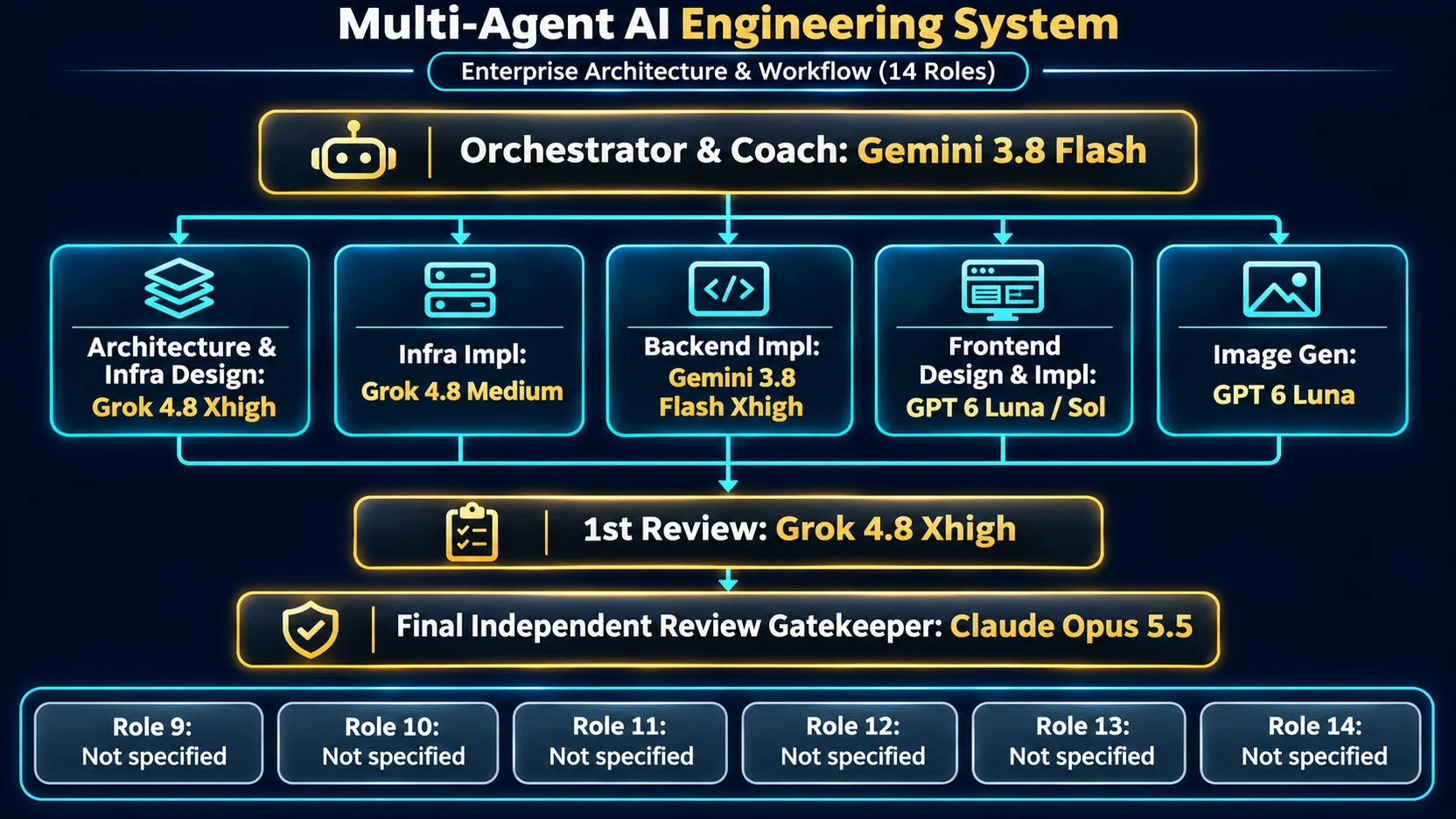
The specific models in charge and role distribution for each phase are broken down in detail as follows.
| Domain | Role | Assigned Model | Execution Platform / CLI | Main Responsibilities |
|---|---|---|---|---|
| General Management/Command | Orchestrator | Gemini 3.8 Flash | Agy Core / API | Task decomposition, difficulty assessment, prompt generation, progress management (direct task execution prohibited) |
| General Management/Dialogue | Coach | Gemini 3.8 Flash | Agy Core / API | Specification brainstorming, requirement definition deep-dive, decision support (low-latency dialogue) |
| Routine Tasks | Bulk Worker | Gemini 3.8 Flash | Agy Core / API | Mass file formatting, log analysis, document generation, routine parallel scanning |
| Design | Architecture Design | Grok 4.8 Xhigh | Grok Build CLI (grok -p) ➔ Grok API | System-wide structure, DB schema, API interface (shared contract) definition |
| Design | Infrastructure Design | Grok 4.8 Xhigh | Grok Build CLI (grok -p) ➔ Grok API | Server configuration, network, logical design of IaC (Terraform/Docker, etc.) |
| Implementation | Infrastructure Implementation | Grok 4.8 Medium | Grok Build CLI (grok -p) ➔ Grok API | Implementation and verification of IaC code and build scripts based on design documents (cost optimization) |
| Frontend | Frontend Design (Standard) | GPT 6 Luna | Codex CLI (codex exec -m gpt-6-luna) ➔ OpenAI API | Standard screen design, component splitting, and standard data flow definition |
| Frontend | Frontend Design (High Difficulty) | GPT 6 Sol | Codex CLI (codex exec -m gpt-6-sol) ➔ OpenAI API | Complex state management, real-time communication, and advanced rendering/performance-critical design |
| Frontend | Frontend Implementation | GPT 6 Luna | Codex CLI (codex exec -m gpt-6-luna) ➔ OpenAI API | UI implementation based on design documents, Tailwind styling, and screen logic implementation |
| Frontend | Image Generation | GPT 6 Luna | Codex CLI / OpenAI Image (gptimage-exec) | High-quality image generation for UI assets, icons, OGP, eye-catching images, etc. |
| Backend | Backend Design | Grok 4.8 Xhigh | Grok Build CLI (grok -p) ➔ Grok API | Domain logic design, endpoint specifications, and asynchronous/exception design |
| Backend | Backend Implementation | Gemini 3.8 Flash Xhigh | Agy Core / Gemini CLI | Business logic implementation based on design documents, unit test creation (high-speed parallel implementation) |
| Review | Frontend Review | Grok 4.8 Xhigh | Grok Build CLI (grok -p) ➔ Grok API | Primary cross-check for type safety, accessibility, and architectural consistency |
| Review | Backend Review | Grok 4.8 Xhigh | Grok Build CLI (grok -p) ➔ Grok API | Logic verification, edge case confirmation, test passing/type safety primary verification |
| Final Audit | Independent Review (Gatekeeper) | Claude Opus 5.5 | Google Plan ➔ Claude Pro ➔ Claude API | Final line of defense. Evaluates only system-wide side effects and critical defects in the primary pass diff |
Separating frontend design by difficulty and consistent implementation with Luna
One of the major points in this reorganization is the configuration where frontend design is separated by difficulty, and implementation and image asset generation are consistently entrusted to the lightweight GPT model, "Luna."
- Standard screen design: Normal component splitting and data flow definition are handled by the agile GPT 6 Luna.
- High-difficulty design: Specialized design involving complex state management, real-time communication, and advanced rendering (Three.js, Canvas, etc.) is handled by the highly inferential GPT 6 Sol.
- Implementation & Image Generation: UI implementation based on design documents (Tailwind CSS styling and screen logic) and image asset generation are all consistently handled by GPT 6 Luna.
Previously, we sometimes relied on large models for everything, but the lightweight Luna model has extremely fast response times and is very stable in terms of UI component granularity and styling sense.
By standardizing the entire process from design to implementation and asset generation within the GPT series, the design tone and manner and data flow between components have become less prone to inconsistency. By entrusting only high-difficulty design to Sol and relying on Luna for consistent implementation, we have achieved both agility and robustness.
Positioning Grok for design and primary review, and maximizing implementation throughput with Flash Xhigh
We have positioned xAI's "Grok" for infrastructure design, architecture design, backend design, and primary code review.
Grok's strength lies in its broad perspective on logical structural design and its overwhelming processing speed and cost-performance. We position it as the linchpin for maximizing overall development throughput, primarily from a "cost and speed-oriented" perspective.
The actual writing of backend implementation code is handled entirely by Gemini 3.8 Flash Xhigh. Based on the robust design documents and API interface definitions established by Grok, Flash Xhigh performs parallel implementation at ultra-high speed, preventing design drift while achieving overwhelming implementation speed.
Furthermore, Grok also handles the primary review of the implemented code (syntax check, type safety, test passing, consistency with design documents). By having Grok objectively perform the primary screening for both the frontend (implemented by GPT Luna) and the backend (implemented by Flash Xhigh), we can reliably weed out mechanical flaws and type mismatches at an early stage.
Positioning Opus 5.5 as the "Final Independent Review": Prioritizing verification over design
What we were most conscious of this time is how to use Anthropic's "Claude Opus 5.5."
While Opus 5.5 has extremely high reasoning capabilities, using it for all daily implementation and design tasks consumes quotas rapidly and often becomes a bottleneck in terms of speed.
Therefore, we strictly followed the policy of "Prioritizing final verification over design."We pass only the changes (git diff) that have completely cleared the primary review (Grok) and the design intent to Opus 5.5. It operates as a final line of defense (gatekeeper) to verify only critical issues (Critical / High) that affect the entire system, such as "architectural inconsistencies," "overlooked security risks," and "asynchronous processing race bugs," rather than code preferences or minor style corrections.
By completely separating it from daily minor tasks and strictly auditing only the elite diffs that have passed the primary screening, we ensure maximum safety with limited resources.
Consolidating coaching and command roles into Gemini Flash to achieve low-latency dialogue
For the "coach" role, which provides brainstorming on specifications, deep dives into requirement definitions, and inline decision-making support during implementation, we have deployed
Gemini 3.8 Flash**, the same as the orchestrator (command tower).**In the brainstorming phase where thoughts are exchanged rapidly, "response speed (low latency)" is what creates the groove of thought. By using Gemini Flash, which returns answers instantly, as a dialogue partner, we can now organize design points without stress.
Crossing different AI labs to prevent "echo chambers"
When a single AI model performs "design ➔ implementation ➔ review" consistently, it is easy to fall into a self-affirmation bias (echo chamber phenomenon) where one cannot doubt one's own premises, just like in human organizations.
Command Tower, Coach, BE Implementation
- : Google (Gemini 3.8 Flash / Flash Xhigh): Google(Gemini 3.8 Flash / Flash Xhigh)
- Design & Primary Review: xAI (Grok 4.8)
- Frontend (Design, Implementation, Images): OpenAI (GPT 6 Luna / High-Difficulty Design: GPT 6 Sol)
- Final Independent Review: Anthropic (Claude Opus 5.5)
By cross-referencing models from four companies with different philosophies and training data, a cross-check system naturally functions to compensate for each other's quirks and blind spots. The structure where reviewers from different labs sharply identify design flaws that the implementer missed contributes significantly to the stability of code quality.
Subscription Configuration and Monthly Cost Breakdown
The breakdown of the subscriptions supporting this multi-AI agent configuration is as follows.
| Service/Plan | Monthly Cost | Primary Role |
|---|---|---|
| Google AI Ultra (20x Tier) | 199.99) | Orchestrator, Coach (low-latency dialogue), and ultra-fast backend parallel implementation |
| The X Subscription Super | $100 / month | Architecture, Infrastructure, Backend Design, and Primary Code Review |
| ChatGPT Plus | $20 / month (approx. $22 incl. tax) | Frontend Design (Luna/Sol), UI Implementation, and Image Asset Generation |
| Claude Pro | $20 / month (approx. $22 incl. tax) | Independent Code Review as Final Gatekeeper (Opus 5.5) |
Total: Approx. 344 per month (approx. 50,000–55,000 JPY)
By securing high-tier plans for key areas (Google's 20x tier, X's Super tier) while keeping confirmation-only Claude and frontend-specialized GPT at standard Pro/Plus plans, we achieve efficient cost allocation. Furthermore, we have established a multi-layered hierarchy for model calls—prioritizing fixed-rate subscription quotas (Google Plan / Grok Build / Codex CLI) and falling back to API when exhausted—to prevent runaway usage costs. Considering that we have a 24-hour development team with multiple audits at this monthly cost, the development speed and peace of mind gained are immense.
Conclusion
AI-assisted development is evolving from the stage of 'dumping everything on one smart model' to 'forming a small team with multiple models of different characteristics, and establishing appropriate command chains and audit flows.'
Solidify requirements with low-latency dialogue, build the frontend nimbly by trusting lightweight models, gain throughput with design and primary reviews, and guard the final gate with the top-tier model. This well-balanced configuration makes daily development lighter and more reliable.