
Diary
The next frontier for information engineering lies in 'mechatronics'. The limits of regional mobility I felt keenly in Kihoku Town, and 'my hobby' of taking on extreme tuning.

Today, I visited Kihoku Town, nestled between the rich sea and deep mountains in the south of the Kii Peninsula.
I had time to sit down with local residents and stakeholders to discuss the reality of 'mobility' that the region is currently facing.
Not limited to Kihoku Town, walking through any rural town leads to the same pressing reality. As aging progresses and more elderly people return their driver's licenses, bus routes are being reduced or discontinued, and taxi companies are struggling to operate at night or on holidays due to the aging of drivers and labor shortages.
In villages with many slopes and narrow, winding alleys, even walking to the nearest bus stop is a struggle. Trips to the hospital, daily shopping, or minor errands at the town office. The 'freedom of movement' that was once taken for granted is beginning to crumble with a sound.
While facing these issues, several thoughts in my mind have strongly connected, and are beginning to grow into a single conviction.
That is,**'Isn't the next frontier to truly make the information technology (software, AI, distributed systems) I have cultivated useful to the world to master the mechatronics domain (mechanical, electrical, electronic, mechatronics) and step into robotics and autonomous driving?'**is that intuition.
Where is the next frontier to utilize information technology?
Until now, I have run through the fields of pure information engineering such as software, cloud, autonomous AI agents, and distributed databases. In the logical world inside the screen, one can create dozens of times more efficiency or new value with a single way of writing code or a single architectural design.
Of course, I also feel intense interest and intellectual curiosity in the DX of the chemical field (material informatics and drug discovery) and the agriculture, forestry, and fisheries field (smart agriculture and marine resource management) as places where information technology can seep into. All of them are wonderful fields that support the foundation of human life.
However, when I deeply introspected, 'Where is the field where I can maximize the information technology I have cultivated, be most beneficial to the world, help people in need, and make a fundamental contribution?', my gaze naturally turns to**'Mechatronics domain (robotics/autonomous driving)'**towards.
Because what is screaming the loudest in local fields right now is not 'information' but the 'lack of physical manpower and movement'.
No matter how neatly the data on the screen is organized, the wheels that carry the elderly to the hospital will not turn on their own. Unless the pure logic of software can be converted into 'physical phenomena' such as motor rotation, steering, battery charging/discharging, and spatial recognition by sensors, real social infrastructure cannot be saved.
| Domain | Synergy with Information Technology (AI/Software) | Direct Impact on Local Community | Barriers to Entry and Social Benefit upon Resolution |
|---|---|---|---|
| Chemical/Material Domain | Simulation acceleration, automation of new material discovery | Medium to long term (productization of new materials takes years) | Requires specialized equipment and advanced experimental environments. Industrial ripple effect upon resolution is enormous |
| Agriculture/Forestry/Fisheries Domain | Growth monitoring, sorting via image analysis, harvest prediction | High (labor saving for primary industry, measures against aging) | High uncertainty in natural environment/weather, requires individual adaptation for each field/fishing ground |
| Information/Communication/DX Domain | Business automation, AI agent coordination, data integration | High immediate effect (dramatic efficiency in back office/decision making) | Barriers to entry are low, but it stays within screen optimization and cannot directly solve physical movement |
| Mechatronics Domain (Robotics/Autonomous Driving) | Autonomous control, edge inference, direct connection to extreme cost optimization | Extremely urgent and immediate (maintenance of daily transport, defense of logistics/rescue) | Barriers of mechanical design, regulations, and safety are extremely high, but it saves the survival of the local community from the foundation |
When information technology connects with the physical world, the flow of its value draws the following layer structure.
Combining the logic of information technology with the gritty physical world of mechatronics. I strongly feel that this is the frontier I should challenge next.
The harsh reality of 'regional mobility' discussed in Kihoku Town today
Today, while talking with local people in Kihoku Town, the 'essential structural problem' that regional mobility holds became clear.
Regional mobility is piled high with countless difficulties. But the biggest wall at the root of all problems is extremely simple.'Cost' and 'business profitability' absolutely do not matchthat is.
In towns with low population density, the number of passengers is limited. Demand for travel is concentrated in specific time zones, such as morning hospital visits and evening returns home, and empty cars are conspicuous during the day. On the other hand, vehicle introduction costs, insurance premiums, fuel/electricity costs, vehicle inspection and maintenance costs, and above all, driver labor costs are incurred reliably every month.
Even if a private company enters as a for-profit business, it will withdraw within a few months at the earliest, or a few years at the longest, unable to bear the deficit. Operators do not take root.
And currently, what is the reality of the mechanisms that are somehow maintaining local transportation across municipalities nationwide?**The reality is that local governments are pouring in large amounts of tax money (subsidies) to cover the annual deficits of private operators, barely keeping them running.**That is the reality.
To maintain the operation of a single vehicle, millions to over ten million yen of public funds disappear annually. For municipalities where tax revenue continues to decline due to depopulation, the continuation of this deficit coverage is a burden that is gradually strangling their finances.
When I faced this reality, I felt it keenly.
The very premise of viewing regional mobility as a 'business for private companies to make a profit' is fundamentally broken.
This is no longer a commercial enterprise. It must be re-envisioned as,**'highly public social maintenance infrastructure that is absolutely essential for residents to live there,'**just like roads, water supply, and sewage systems.
Why software alone cannot solve it: Regional optimization of hardware and extreme cost tuning
So, how can we make that public infrastructure sustainable?
In the context of recent smart cities and MaaS, many software-driven solutions are discussed, such as 'let's introduce ride-hailing apps' or 'let's optimize routes with on-demand dispatch algorithms.'
However, the more I look at the field,**'this structural challenge can never be solved by a software-only approach,'**I hit upon that cold, hard fact.
No matter how smart the dispatch algorithm is, if the vehicles being operated are existing large route buses or commercial luxury minivan EVs costing 7 to 10 million yen each, the fundamental cost structure does not change at all. High vehicle prices, high inspection costs, expensive replacement parts, and the physical constraint of being unable to enter narrow village alleys stand in the way.
The same applies to 'autonomous driving vehicles for demonstration experiments' where high-precision LiDAR or high-spec in-vehicle servers costing hundreds of thousands to millions of yen are bolted onto existing vehicles. Even if they can be operated with subsidies during the demonstration period, once the experiment ends, the maintenance costs cannot be paid, and they end up sleeping in a garage.
What is essential to break through this wall is,**'optimizing the hardware (vehicle, undercarriage, sensors, control mechanisms) itself for local road conditions and mobility needs, stripping away unnecessary specs to the extreme, and tightly tuning the introduction and maintenance costs.'**This is it.
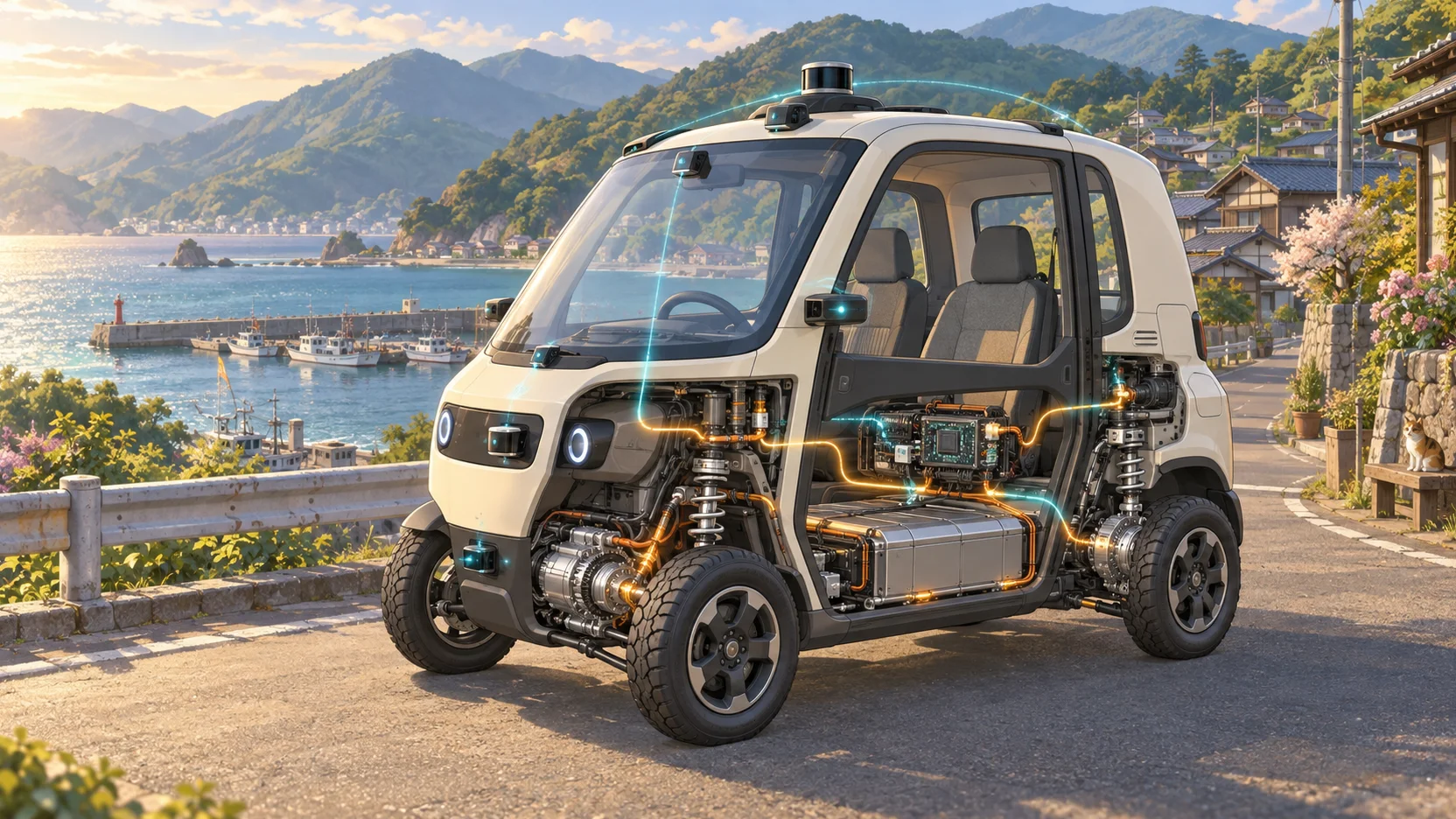
Performance to speed along main roads at 60 km/h is not needed. It is enough to be able to run safely on narrow alleys at 15-20 km/h. Instead of luxurious air conditioning or heavy collision-safety bodies, it features a lightweight, simple frame and a compact vehicle width that can slip through residential roads. The sensors are not excessive, ultra-high-end LiDAR, but a combination of low-cost sensor arrays specialized for low-speed driving and edge AI.
| Approach | Initial Introduction Cost | Annual Maintenance/Running | Suitability for Local Roads | Sustainability for Municipality |
|---|---|---|---|---|
| ① Software-only approach(Introduction of ride-hailing apps/reservation systems) | Development/Introduction costs of several million yen+ | High (Personnel costs for existing vehicles and dedicated drivers remain) | Low to Medium (Cannot enter narrow roads as they use existing large vehicles or vans) | ✕ (Fundamental deficit structure is not resolved, subsidies swell) |
| ② Existing general-purpose EV + Autonomous driving for demonstration(Expensive commercial vehicles + full-spec LiDAR) | Extremely high (15 million to over 30 million yen per vehicle) | Extremely high (Huge maintenance and license fees for special sensors) | Low (Vehicle width is wide, cannot pass in narrow slopes or alleys in depopulated areas) | ✕ (Withdrawal due to budget depletion as soon as the demonstration experiment ends) |
| ③ Electromechanical regional optimization × Extreme tuning(Dedicated micro EV + lightweight edge AI) | Minimized (Stripping away unnecessary equipment to under several million yen) | Minimal (Household power charging, general-purpose consumable parts, remote monitoring) | Extremely high (Reaches deep into alleys with a width less than a light truck) | ◯ (Public maintenance can be sustained permanently with a budget suited to the scale) |
Subtracting from a zero base to match hardware to local realities, and tightly coupling software and AI to it.
You can never reach this solution with just hardware or just software. Only engineering that understands both and has the courage to strip away what is unnecessary can break through this dead end.
The reason I take this on not as 'work,' but as a 'life pursuit/hobby'
If asked, 'Is this FLARES work?', I would shake my head.
My main business is supporting corporate DX, cloud infrastructure design, and developing autonomous AI systems. Stepping into the electromechanical domain, tinkering with mobility hardware, and struggling with control engineering is a bit outside the domain of contract development or my company's business.
However, as long as I think within the framework of cost-benefit analysis or 'whether it is profitable as a business' or 'whether there is a budget for a contract,' no one can touch this massive, muddy, and unprofitable challenge of regional transportation.
That is precisely why I stopped calling this 'work'.
This is my 'life's pursuit' and my 'hobby'.
Calling it a 'hobby' might sound trivial, but for me, it is the exact opposite.
Precisely because it is a hobby, I am not bound by quarterly sales or break-even points. I don't need to ask for permission from anyone, nor do I need to worry about what shareholders think. I can immerse myself in extreme cost tuning and trial and error, disregarding profitability until I am satisfied.
Pouring all my information technology expertise into it, learning the physical world of mechanical and electrical engineering, and facing the reality of the region. Is there any other 'hobby' as luxurious, proud, and intellectually thrilling as this?
Drowsiness in the car heading to Yokkaichi and a lonely resolve for the future of Higashi-Kishu
At dusk, after finishing discussions in Kihoku Town, I am driving my car toward Yokkaichi.
When my brain begins to tackle such fundamental, complex, and heavy questions that are not easy to solve, it seems to exhaust its resources to the limit, and an intense drowsiness washes over me.
I pay close attention to driving, stopping at parking areas along the way to take deep breaths, and while drifting in and out of consciousness, I issue instructions to my AI agent and write down my thoughts as a diary like this.
Suddenly, staring into the darkness beyond the windshield, I ask myself in my heart.
'Will this hobby of mine ever bear fruit?'
'Can I truly make this Higashi-Kishu, and the future of the region, better?'
Perhaps, if I don't do it, no one else will.
For large corporations, the market is too small to justify entry, and local businesses lack the technical resources to integrate mechanical/electrical engineering with advanced software.
That is why I am doing it.
From beginning to end, it might be a lonely endeavor that no one understands. It is a challenge like groping through the dark with no guarantees.
Even so, I have no intention of extinguishing this quiet heat lit within my chest.
For now, holding this thought in my heart, I want to patiently wait for the moment when my own thinking leads to a clear answer and a blueprint.