
Diary
How to reverse-engineer a 'winning business' from numbers. A complete analytical method for new business development that uncovers winning paths from statistics and distortions in job opening ratios.

When considering launching a new business, most discussions in the world start from 'hunches' such as 'what kind of groundbreaking idea is it?' or 'what can be done with the latest AI or technology?'
However, in actual business development, most projects that start with an idea-first approach fail. Customers' purse strings are not that loose. Even if they say, 'That's interesting,' whether they will actually pay and sign a contract is an entirely different matter.
So, where do truly winning new businesses come from?
In conclusion,**It comes from reverse-engineering based on 'objective numerical distortions (gaps).'**By completely eliminating emotions and assumptions, we coldly cross-reference publicly available statistical data (sales by industry, concentration by company size, effective job opening ratios by occupation at Hello Work, number of business establishments). Then, in a specific region, a specific industry, and a specific field,
'An area where it is structurally impossible to hire people, the site is reaching its limit, and cash leakage (losses) that cannot be filled by existing IT products is occurring'**will emerge as clearly as if you had taken an X-ray.**This time, using our own
'Mie Prefecture IT Business Opportunity Proposal'andDetailed Data Book (a statistical compilation of 20 sheets)as examples,'Where to look in the numbers and how to interpret them to see the outline of a winning new business'**I want to reveal the entire thought process and concrete business design.**Furthermore, I will explain in detail the steps for anyone to fully reproduce this advanced data analysis and strategy formulation at hand using GPT.
- Solving the numerical trap: Do not be deceived by 'huge sales'
The most common mistake in new business market research is to jump to the conclusion that 'a market with large sales volume = a promising market to enter.'
Let's look at the manufacturing industry data for Yokkaichi City, Mie Prefecture, in our data book.
Looking only at the huge figure of over 3 trillion yen, one might think, 'Let's launch a factory DX or smart factory business for manufacturers in Yokkaichi.'
【Yokkaichi City Manufacturing Industry Data (2020-2021 Results)】
・Value of manufactured goods shipped: Approximately 3.1357 trillion JPY
・Number of employees: Approximately 45,000 people
However, here is
the first trap of numbers.**When we break down this 3 trillion yen by 'company size (number of employees),' a shocking bias emerges.**In fact, 77.0% (approximately 2.4778 trillion yen) of the value of manufactured goods shipped in Yokkaichi City is generated by only '15 establishments' with 300 or more employees
(petrochemical complexes, major semiconductor companies, major automotive affiliates, etc.).
These 15 large-scale bases have their overall design controlled by the information systems departments of their headquarters in Tokyo or Osaka, and major mega-SIers build their core systems. There is extremely little room for local independent operators or startups to enter.**First guideline derived from numbers: Strip away large-enterprise concentration and count the 'independent customer base'**So, is there no room for entry? That is not the case.
Even if we exclude the 77% accounted for by large enterprises, the remaining market size is still
657.9 billion yen.
If we broaden our perspective and count the number of establishments in peripheral industries that support the manufacturing supply chain with '10-99 employees (a size where you can approach site managers or presidents directly and have a certain amount of payment capacity),' a realistic customer base appears.
Road freight transport (10-99 employees): 769 bases in Mie PrefectureWarehousing and logistics support (10-99 employees)
: Dozens of bases, mainly in the Hokusei and Chusei regions
- Corporate specialized wholesale: Hundreds of bases, mainly in Hokusei, Tsu, and MatsusakaThe moment you discard the illusion of a '3 trillion yen manufacturing industry' and identify the real customer pool of '769 transport companies and specialized wholesalers actually existing in the prefecture,' the target of the business becomes extremely clear.
- ---: Dozens of locations, mainly in Hokusei and Chusei
- Specialized wholesale for corporations: Hundreds of locations, mainly in Hokusei, Tsu, and Matsusaka
The moment we abandoned the illusion of a "3 trillion yen manufacturing industry" and identified the realistic customer pool of "769 existing transportation and specialized wholesale companies within the prefecture," our business target became extremely clear.
2. Extreme distortion in labor supply and demand: Business opportunities exist in fields with a 'job opening-to-applicant ratio exceeding 3-4 times'
Next, we cross-reference the data from the 'Effective Job Opening-to-Applicant Ratio by Hello Work Jurisdiction and Occupation' published monthly by the Mie Labor Bureau of the Ministry of Health, Labour and Welfare.
No matter how large the industrial sales are, if the frontline is not in trouble, there is no motivation to pay for new services.
The strongest figure that objectively shows 'how seriously the frontline is struggling' is**the distortion (gap) in the effective job opening-to-applicant ratio.**This is it.
【Job Opening-to-Applicant Ratios by Hello Work Jurisdiction in Mie Prefecture (Autumn 2026 Latest Data)】
・Yokkaichi Jurisdiction / Automobile Driving & Transport Occupations: 3.40x (555 job openings / 163 applicants)
・Prefecture-wide / Machine Maintenance & Repair Occupations: 3.64x (586 job openings / 161 applicants)
・Prefecture-wide / Production Process Occupations (Manufacturing Sites): 2.26x (Numerous job openings / Chronic labor shortage)
・Prefecture-wide / General Office Occupations: Approx. 0.4x (Excess applicants / Buyer's market)
Figures such as the '3.40x' job opening ratio for transportation/logistics jobs and '3.64x' for mechanical maintenance jobs.
Combined with the 2024 Problem (overtime work cap regulations), this clearly shows the reality that hiring drivers and operation managers has become extremely difficult.
What is happening on the frontlines of logistics and transportation companies?
Operation managers and dispatchers are chased by severe dispatch scheduling every morning and evening, while during the day, they are overwhelmed by sudden delivery requests from shippers and phone calls/emails regarding time changes.
And in the evening, what awaits them in the office is**'a massive amount of paper slip processing'.**This is it.
They manually input data into their own operation management software or Excel while looking at faxed or PDF order forms that have different formats for each shipper.
They flip through the stack of receipts brought back by drivers one by one and cross-check them with actual operation records.
They manually calculate 'waiting time fees,' 'highway toll reimbursements,' and 'incidental work fees' to create end-of-month invoices.
Since the ratio for general clerical jobs is 0.4x, it is possible to hire clerks, but they do not understand the complex freight rates and special product naming rules for each shipper, so in the end, veteran dispatchers and operations managers work overtime until late at night to perform the verification work.
The second guideline derived from the numbers: Create a business that 'eliminates the administrative work of frontline managers who are hard to hire' rather than 'increasing headcount'.
The winning strategy for the business naturally becomes clear.
**A business that 'completely takes away repetitive administrative tasks such as order intake, receipt verification, and invoice data creation from the hands of operation managers and business leaders who cannot be hired, and restores time for their core business of dispatch and operation management'.**This is it.
This business proposal becomes a desperately needed solution for logistics executives caught between labor shortages and labor time regulations.
3. Visualizing the winning strategy with a 'Industrial Sales' x 'Job Opening Ratio' 4-quadrant matrix
The most powerful analytical method we practiced with our data book is**a 4-quadrant matrix analysis using two axes: 'Sales by Industry (market size/payment capacity)' x 'Job Opening Ratio of related occupations (depth of frontline pain/degree of labor shortage)'.**This is it.
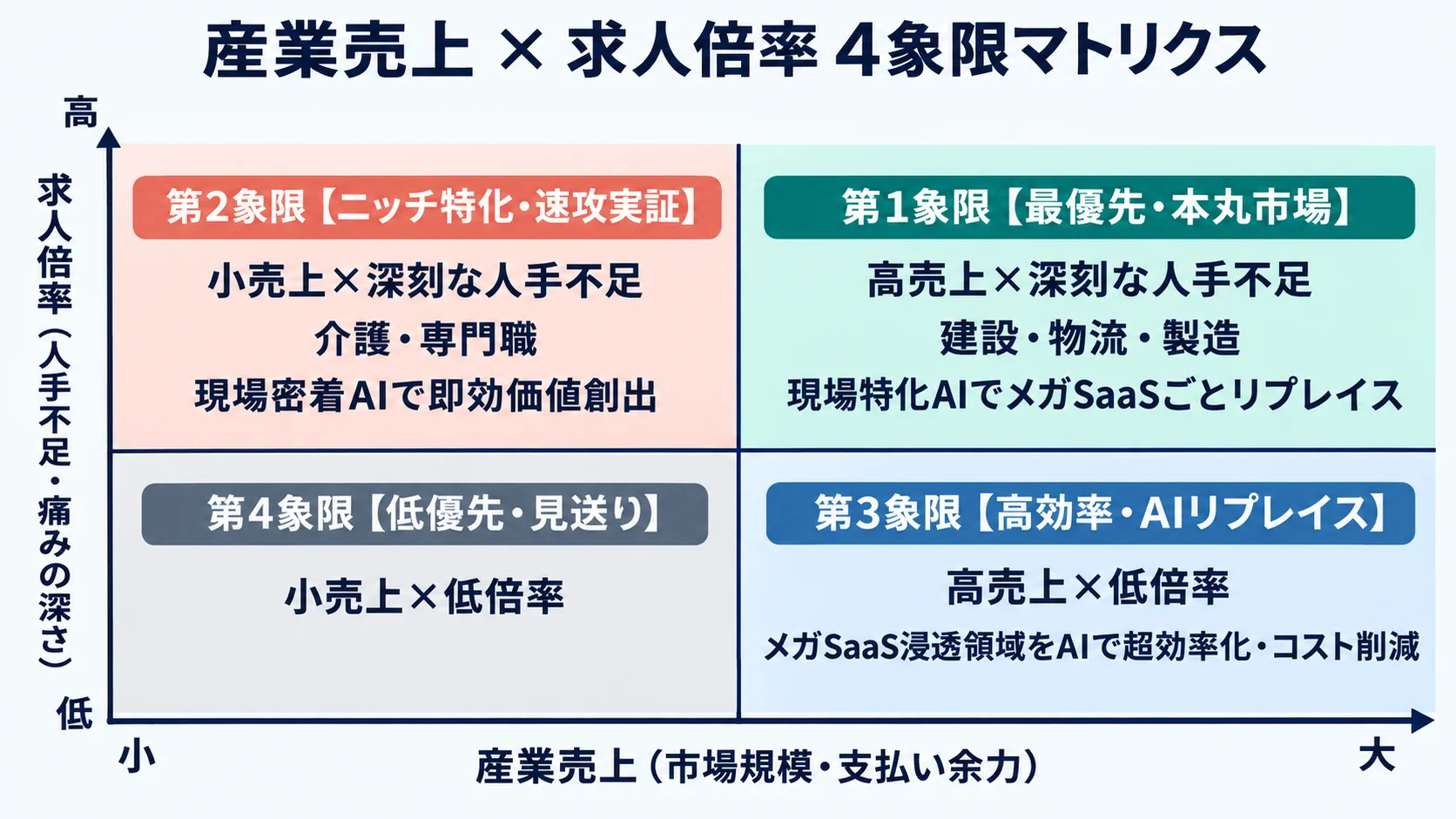
By taking 'Job Opening Ratio (frontline urgency)' on the vertical axis and 'Industrial Sales (market size/budget size)' on the horizontal axis, we plot the industries within the region into four quadrants. This logically and mathematically highlights the business areas to enter and their priorities.
When applying the data of 29 cities/towns and 9 jurisdictions in the prefecture to this 4-quadrant matrix, the strategic meaning of each quadrant is defined as follows.
- [Quadrant 1: Top Priority/Main Market] (High Sales x High Ratio):
- Logistics, transportation, warehousing, specialized wholesale, and manufacturing in Yokkaichi, Suzuka, Kuwana, and Tsu: There is a solid economic foundation with 303.1 billion yen in transportation sales (Yokkaichi alone), and the job opening ratio reaches 3.40x. While they have sufficient IT investment budgets, they are facing a crisis of business suspension due to the 2024 Problem and labor shortages. This is the main market where we aim for the maximum return by introducing a frontline-specialized AI vertically integrated system and replacing existing mega-SaaS.
- [Quadrant 2: Niche Specialization/Rapid Proof] (Low Sales x High Ratio):
- Nursing care/welfare, specialized professional services, local food and beverage services: Although the payment capacity and market size per company are limited, the pain of labor shortage is severe, and there is a sense of urgency to 'help me right now.' It functions as a foothold area to achieve immediate results and gain track record/trust (PoC) with frontline-integrated lightweight AI tools.
- [Quadrant 3: High Efficiency/AI Replacement] (High Sales x Low Ratio):
- General administration, large/mid-sized back office, finance/general affairs: The job opening ratio is about 0.4x, which is a buyer's market, and at first glance, the screams of labor shortage are not heard. However, industrial sales are large, and high mega-SaaS license fees and indirect labor costs are piling up. This is a high-efficiency market where we launch business consolidation, cost halving, and existing mega-SaaS replacement using AI agents, rather than solving labor shortages.
- [Quadrant 4: Low Priority/Pass] (Low Sales x Low Ratio):
- Regions with small total industrial sales (Owase, Kumano, etc., around 170 billion yen scale) or industries with strict unit price constraints: There is little payment capacity, and the urgency of labor shortage is also low. Since individual custom development would not be profitable for the developer and both would collapse, this is an area that should be limited to introducing general-purpose off-the-shelf products or, in principle, avoided.
4. 'Not competing with mega-SaaS' is a declaration of defeat in the AI era: Vertical integration strategy to replace entire mega-SaaS with frontline-specialized AI
Once the target industry to enter (Quadrant 1) is determined, the next step is product design for 'what specifically to provide and receive payment for'.
During the heyday of the cloud, the standard for new businesses was 'do not fight existing mega-SaaS,' 'focus on API integration and glue code, and pick up the gaps of mega-SaaS.' This was because software development at the time required huge investments of tens of millions of yen or more and years of development time, and challenging Salesforce, freee, Money Forward, or major industry-specific packages head-on was suicidal.
However,Now that the AI era (ultra-high-speed, low-cost vertically integrated development using generative AI and autonomous AI agents) has arrived, that conventional wisdom is completely a thing of the past.
There is no need to settle for 'glue business' that picks up crumbs falling through the gaps of mega-SaaS. Rather,**replacing, encompassing, or surpassing existing mega-SaaS itself with a field-specialized AI-native integration platform is the most realistic and powerful path to victory.**is.
Why mega-SaaS fails in the field: The limits of the 'greatest common divisor'
Why do small and medium-sized enterprises and local sites not become any easier to manage even after introducing expensive mega-SaaS?
The reason is that mega-SaaS is**made for the 'greatest common divisor of all companies nationwide'.**Because it is made with,
Complexity of screens and forced human input:
Countless setting items and pull-downs are lined up to meet the requirements of every company, and in the end, it only works if a human sits in front of a PC and manually clicks to input structured data.
Rejection of unstructured data:
Mega-SaaS does not accept even a millimeter of the 'faxes with different formats for each shipper', 'distorted PDFs', 'handwritten receipts from drivers', and 'sudden changes in destination via phone' that overflow in the field.
Cost inflation due to account billing (seat billing):
Since ID costs jump for every person involved, it cannot be distributed to everyone on-site, and some employees are overworked as 'input agents'.
As a result, in the field,**'Drafting in Excel first to input into mega-SaaS', 'Exporting CSV from SaaS and manually pouring it into another SaaS'**such counterproductive double work and fragmentation are rampant.
The overwhelming advantage of a 'frontal breakthrough' by field-specialized AI
An AI agent-native integrated system strikes directly at this weak point of mega-SaaS.
Direct processing of unstructured data:
Multimodal AI interprets fax orders and handwritten delivery receipts as they are, and autonomously executes product code conversion and freight tariff application through inference. It does not ask humans to input structured data.
Vertical integration from order to billing:
Processes that were previously divided into 4-5 individual tools, such as order intake, vehicle dispatch, receipt matching, incidental freight calculation, and invoice issuance, are integrated into a single field-specialized AI platform.
Making mega-SaaS screens unnecessary:
Even if a customer cannot immediately cancel their existing core system, there is no need for a human to open the mega-SaaS screen. AI automatically synchronizes data via backend APIs or headless operations, and the frontend operation experience is completely taken over by the company's own AI integration platform. Eventually, customers naturally cancel their expensive mega-SaaS accounts and consolidate into their own systems.
Selling not by '100 hours saved' but by 'mega-SaaS cancellation + elimination of cash leakage'
Many IT vendors appeal, 'You can save 100 hours of work per month by using this tool.'
However, as the 'Proof of Profitability_Assumption' sheet in the data book shows,**of the value of time saved (300,000 yen in hourly wage conversion), the proportion that actually reduces the company's cash expenditure (overtime pay and outsourcing costs) is at most 30% (about 90,000 yen per month).**If you try to sell a tool with an initial cost of 1.2 million yen and a monthly fee of 60,000 yen based solely on 'time savings', it will take many months to recover, and management will not approve it.
However,**combining 'reduction of mega-SaaS licenses' and 'elimination of cash leakage (billing omissions/shipping errors)'**when presenting a vertically integrated model, the ROI figures jump dramatically.
【Estimated Monthly Economic Value Delivered by On-site Specialized AI Vertical Integration System】
① Cancellation/Integration of multiple existing mega-SaaS contracts: Actual cost reduction of ¥80,000 to ¥150,000 per month
② Elimination of missed billing for standby fees, advance payments, and incidental work buried in slips: Revenue recovery of ¥120,000 to ¥200,000 per month
③ Prevention of round-trip shipping losses due to part number input errors and incorrect shipments: Loss avoidance of ¥40,000 to ¥80,000 per month
④ Reduction of late-night overtime for hard-to-hire site managers (reduction in actual expenditure): Labor cost suppression of ¥90,000 per month
--------------------------------------------------------------------------------------
⇒ Total: A guaranteed cash improvement of ¥330,000 to ¥520,000 per month!
System usage fees of 60,000 to 100,000 yen per month will pay for themselves in the first month.
Abandon the idea of 'filling the gaps without fighting mega-SaaS','Replace mega-SaaS entirely with field-specialized AI and make cash leakage zero'.. This intense economic return is the one and only positioning in the AI era.
5. 'GPT Complete Reproduction Prompt' to derive a winning strategy from numbers
This series of 'processes for designing a winning business from reading statistical data' can be reproduced at high speed by anyone using GPT.
I will publish a practical prompt that can be used as-is when considering new businesses in your region or industry.
Step 1: Prompt to strip away sales concentration in large enterprises
You are a top analyst for new business development.
Analyze the following municipal industrial statistics data, exclude oligopolies by large corporations, and calculate the "realistic sales target size" where medium-sized and small-to-medium enterprises (SMEs) are the main players.

【Input Data】
Region: 〇〇 Region (e.g., 〇〇 City, 〇〇 Economic Zone)
Shipment Value/Sales by Industry:
・Manufacturing: 〇〇 billion JPY
・Transportation and Postal Services: 〇〇 billion JPY
・Wholesale and Retail Trade: 〇〇 billion JPY
Breakdown by Business Establishment Size (if known): 〇 establishments with 300+ employees, 〇 establishments with 10-99 employees

【Output Requirements】
1. Estimation of sales concentration by top major corporations (analysis of oligopoly degree)
2. Logical organization of reasons why large-scale establishments should be excluded from targets
3. The "number of establishments with 10-99 employees" that your company can directly approach the president or on-site manager, and an evaluation of the potential IT investment capacity of that group of companies
Step 2: Prompt to identify pain points from extreme distortions in job opening ratios
Analyze the following active job opening-to-applicant ratio data by Hello Work jurisdiction and job category, and identify "workplaces where hiring is physically impossible, facing excessive workload for existing employees, or at risk of operational shutdown."

【Input Data】
Jurisdiction: 〇〇 Jurisdiction
Job Openings/Applicants by Job Category:
・Job Category A (Automobile Driving/Transportation): 〇 openings / 〇 applicants (Ratio: 〇x)
・Job Category B (Machinery Maintenance/Repair): 〇 openings / 〇 applicants (Ratio: 〇x)
・Job Category C (General Office Work): 〇 openings / 〇 applicants (Ratio: 〇x)

【Output Requirements】
1. Identification of job categories with extremely high job opening-to-applicant ratios (3x to 5x or more) and an explanation of their abnormality.
2. Hypothesis generation for "administrative tasks and incidental duties that prevent specialists and site managers from focusing on their core work" in those workplaces.
3. Presentation of business areas where an "IT service that eliminates those administrative tasks instead of hiring people" could be viable.
Step 3: Prompt for market entry priority evaluation using a Sales x Ratio 4-quadrant matrix
Please create a 4-quadrant matrix of business areas to enter, by multiplying the "Industry Sales Scale (Market Size / Payment Capacity)" calculated in Step 1 with the "Job Opening Ratio (Severity of On-site Pain / Degree of Labor Shortage)" calculated in Step 2.

【Output Requirements】
1. 【Quadrant 1 (Highest Priority / Core Market)】High Sales × High Ratio: Areas where sufficient payment capacity and severe pain overlap (e.g., logistics/transportation, warehousing, manufacturing, specialized wholesale). Reasons to aim for mega-SaaS replacement and vertical integration with field-specific AI.
2. 【Quadrant 2 (Niche Specialization / Quick Proof)】Low Sales × High Ratio: Areas with limited budget but extreme labor shortages (e.g., nursing care/welfare, specialized professions). Reasons to aim for quick PoC and trust acquisition with lightweight AI.
3. 【Quadrant 3 (High Efficiency / AI Replacement)】High Sales × Low Ratio: Areas with low job opening ratios but huge market sizes (e.g., general office work, back-office for large and mid-sized companies). Reasons to aim for massive cost reduction through business consolidation and mega-SaaS replacement by AI agents.
4. 【Quadrant 4 (Low Priority / Postpone)】Low Sales × Low Ratio: Areas lacking both budget and urgency. Reasons to avoid individual entry and stick to utilizing existing products.
5. Recommendation for a single business domain that your company should launch first with limited resources.
Step 4: Prompt for 'Mega SaaS Replacement' business design through field-specific AI vertical integration
For targeted companies (e.g., transportation companies, warehousing companies, specialized wholesalers),
design a business package that "doesn't just bridge gaps in generic mega-SaaS, but rather encompasses and replaces existing mega-SaaS itself with on-site specialized autonomous AI agents."

[Prerequisites]
・Eliminate operations that force input into existing mega-SaaS screens (dispatch software, WMS, billing/accounting software).
・AI directly interprets on-site faxes, handwritten documents, phone calls, and unstructured data, autonomously processing everything from order placement to dispatch, receipt reconciliation, and billing finalization.
・Present overwhelming ROI not just through "time savings," but also through "mega-SaaS license reduction + prevention of billing omissions/shipping errors + elimination of overtime for core personnel."

[Output Requirements]
1. Service name of the business and a one-phrase value proposition that replaces existing mega-SaaS.
2. Architecture design of the on-site specialized AI vertical integration system (unstructured data input, autonomous inference/reconciliation engine, integrated back office).
3. Overwhelming advantages over existing mega-SaaS and replacement strategy (liberation from the UI hell of lowest common denominator SaaS, reduction of account fees).
4. ROI explanation logic for customers (cost reduction from mega-SaaS cancellation, amount saved from preventing billing omissions, recovery simulation separating actual overtime reduction).
5. Design of the initial "limited 3-company vertical integration AI small-scale paid demonstration (PoC)".
6. Conclusion: Moving straight toward where the numbers point
The most terrifying thing in a new business is 'passionately building something that no one wants.'
However,
- by stripping away large enterprise concentration from regional macro statistics,
- identifying the screams of the field where hiring is impossible from Hello Work job opening ratios,
- defining the core market with an industry sales x job opening ratio 4-quadrant matrix,
- and breaking through the limitations of general-purpose Mega SaaS head-on with field-specific AI vertical integration.
This**'accumulation of numbers'**A business launched by working backward from this has clear customers from the start, urgent budgets from the start, and reasons to win from the start.
Business development is not a gamble waiting for a flash of inspiration from the heavens.
It is an 'extremely logical engineering' process that carefully connects objective numbers at hand to accurately expose the location of customer pain.
Use the GPT at your disposal as the best data analyst to find the 'true path to victory' sleeping deep within the numbers. There, a solid business blueprint that you can follow straight without hesitation should surely be unfolding.