

Good ideas end up as mere impressions
In one workplace, an idea came up to write "next confirmation date" on reception slips. A week later, some said it was "easy to use," while others said it "increased the effort to write." Both are important impressions, but as they are, it's impossible to decide whether to continue or revise. The scenarios and examples in this article are hypothetical.
A common reason is not that the idea is bad, but that what you want to confirm is too broad. "Improving reception" includes response speed, handovers, and burden of entry. If you change everything at once, it becomes difficult to see which change helped what.
First, recall a recent problematic situation. If you write, "The morning after the person in charge was absent, no one knew who was supposed to check what," the subject of the test becomes clear. If you frame it as finding conditions for the next person to continue without confusion, rather than evaluating someone's ability, it becomes easier to bring up problematic points.
Combine thinking, trying, recording, and reviewing into one set
The initial prediction should be written like, "If the confirmation date is left on the reception slip, the person in charge the next day will notice any missed checks." This form allows you to understand what changes will likely affect which situation. Just saying "it will be convenient" doesn't define what to look for.
Next, try it within a reversible scope, such as one task or one reception flow. The period should be roughly the length of one cycle of normal work, and check if busy periods or staff changes are included. For changes affecting safety, laws, or payments, do not try them alone; obtain necessary approvals first.
After trying, separate and record what happened and what you felt. Finally, read the record and decide whether to continue, change the method and try again, or revert. Records where predictions were wrong also serve as material to avoid repeating the same idea.
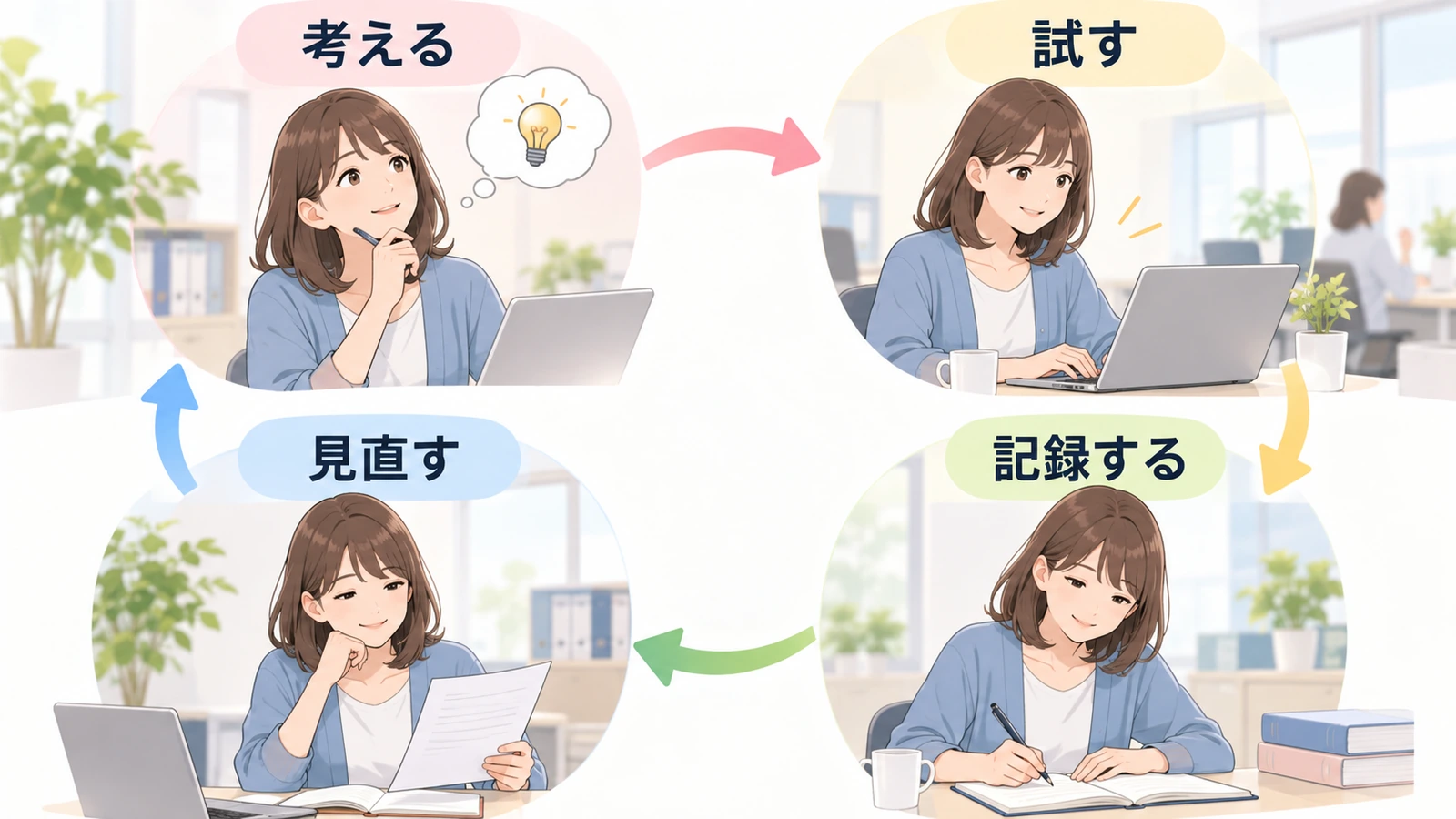
What can be understood from the diagram: It's not enough to just try something; one complete cycle involves reading the records and returning to the next proposal.
Before trying, decide on comparison conditions and stopping conditions
For the reception slip example, look for "situations where the confirmation date was unclear and had to be re-asked the next morning" from records before the trial. Check the same situations after the trial. If comparing numbers, also note the total number of receptions and work content. This is to avoid concluding an improvement based solely on numbers from two days with different levels of busyness.
Keep the number of items to observe small. Choose what is necessary for the next decision, such as the presence/absence of missed checks and areas of confusion in entry. If you ask everyone for detailed time records just to measure, the trial itself becomes a burden. First, consider if existing records can be used for verification.
Also, decide on stopping conditions, such as "revert if the reply deadline cannot be met" or "stop if the record is set to be visible externally." If you align the person in charge of the trial, the person who confirms, and the review date, it becomes easier to prevent the idea from lingering when things get busy.
Records that can be judged later retain specific situations
A vague record is just "Used reception slips. Generally well-received." A record useful for judgment includes the change tried, target, period, what happened, remaining uncertainties, and what to check next. It's not necessary to write everything at length, but it's important that another person in charge doesn't misunderstand the meaning.
A hypothetical example of an entry is: "To try: Added confirmation date field. Target: Regular phone reception. Date to check: After next staff change. Observation: While the next viewing date was clear, I was confused by receptions where the waiting party was not written. Next idea: Also briefly record the waiting party and confirmation details." This is not an example showing actual improvement rates.
With this record, you can discuss not only whether to keep the date field but also how to revise the entry content. The "What to try," "When to check," and "Next decision" in the diagram are entry points for the record. In the results column, please supplement with both good points and problematic points.
Small question
"Inquiries decreased, so the new reception slip is a success," was recorded. Is it okay to decide to continue based solely on this record?
Check if the total number of receptions, types of inquiries, person in charge, or period have changed. If the number of receptions was simply low to begin with, it cannot be attributed to the slip change. Observing actual situations where handovers were smooth without confusion also allows you to record specific reasons for your judgment.
In workplaces with few cases where comparison is difficult, instead of just chasing numbers, a method of checking where confusion occurred during each staff change might be suitable. If safety issues arise, a decision to stop is necessary without waiting for comparison results.

What can be understood from the diagram: It's difficult to decide on the next step based on impressions alone; having a clear idea of what to try, when to verify it, and what the next judgment will be creates an entry point for discussion.
From results different from expectations, choose one point to verify
When things don't go well, don't immediately conclude "the field didn't cooperate"; instead, see if the necessary conditions were met. If reasons include not knowing where to put it, not having time to fill it out, or misunderstanding the meaning of the words to write, then the idea itself and its usage can be considered separately.
Even if good results are obtained, it might be unconfirmed whether it can be used similarly by another person in charge or on a busy day. In that case, expand the scope slightly and try again. Recording "still unknown" for what wasn't understood in the first week doesn't weaken the conclusion; it's an explanation to prevent over-expectation.
In the next trial method, choose one change. If you change the date, person in charge, and arrangement of reception slips simultaneously, the reason for improvement will again become unclear. If multiple changes absolutely must be made, also record that the individual effects cannot be explained separately.
Even with small trials, uncertainties remain
A method that worked in one department may not necessarily work in another. This is due to differences in reception volume, work deadlines, and the perspective of the observer. Also, short periods cannot verify month-end processing or annual tasks. Write the scope to which these results apply, along with the confirmed conditions.
There are also cases where trying is not suitable. Changes like making irreversible promises to others, omitting safety checks, or discarding records that need to be preserved are not subjects for casual comparison. Prepare a reversible method and proceed after confirming with the person responsible for making decisions.
It's also necessary to have an agreement that records are not used to blame staff. Hiding failed situations results in records that look good only during the trial. Even if brief, set aside time to discuss problematic points and confirm with those doing the work whether the method is sustainable.
On review day, read through records before concluding
On review day, the person who tried it and the person who will use it next read the same record. If one reads "a date field would be reassuring" and the other reads "confirmation details are also necessary," ask which situation they are looking at. More than the difference in impressions itself, confirm if the basis for judgment is the same.
An example of a record to keep is: "Points to continue: Writing the confirmation date. Points to revise: Writing the waiting party. Points still unknown: Entry burden on busy days. Next check date: After next staff change." By not summarizing everything into a single word of success or failure, and separating what was learned from what needs to be checked next, the time spent on the trial can be connected to the next task.
This week, try writing one prediction and a review date
Choose one task you are currently struggling with and write one sentence: "What changes will likely affect which situation?" Then, add the record to check, the scope of the trial, and the review date. You can start with a single page that people doing the same work can understand, rather than a large plan.
When reviewing, briefly record both reasons for continuing and reasons for reverting. If records are insufficient, don't rush to a conclusion; decide what to observe next. If trial experiences are accumulated one by one, you will be able to discuss new ideas by referring to previous judgments.
Key points of this article
- Decide the prediction, trial scope, and review date before trying.
- Separate what happened from impressions, and also record the conditions compared.
- From the results, choose one next change, and also record the decision to revert.


